
Build the teaching into 30 days of structured daily practice.
30-Day Challenge Workbook
As a Man Thinketh
Apply the Teaching
30-Day Challenge Workbook for As a Man Thinketh
As a Man Thinketh - 30-Day Challenge Workbook
Allen was precise: thought and character are one. This workbook goes beyond positive thinking into the belief-level work he called 'the heart' - 30 days of structured exercises that actually reach the depth where habitual patterns live.
As a Man Thinketh - 30-Day Digital Workbook
All 30 days of thought-character practice designed for GoodNotes, Notability, and any PDF app. The same belief-level exercises on your tablet - no printing needed.
As a Man Thinketh - 30-Day Fillable Workbook
The full 30-day thought-character programme with fillable form fields - type directly in any PDF reader, no printing required, no app needed.
A look inside
What you get
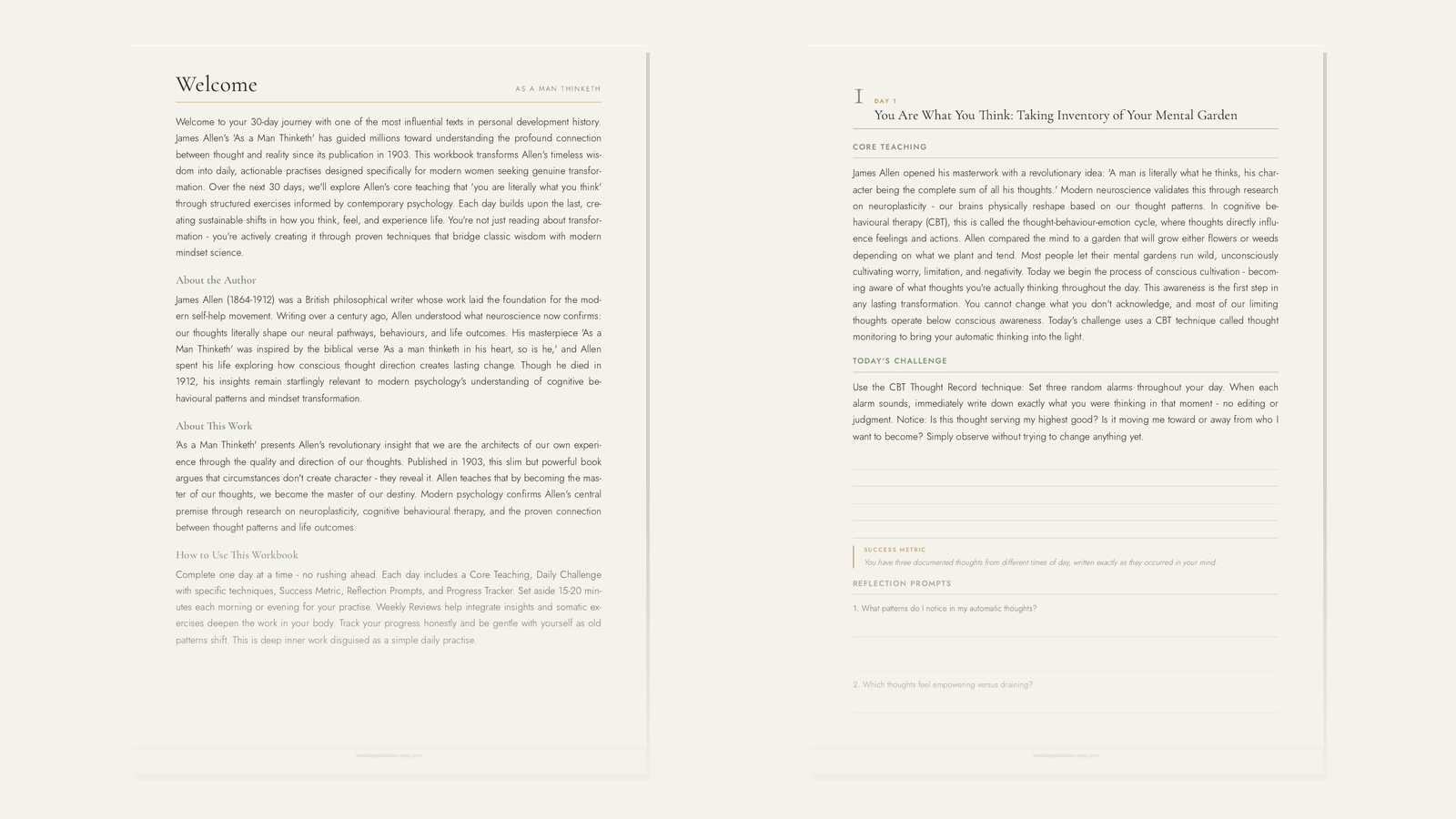
Inside the Workbook
30 days through every section of As a Man Thinketh
Foreword
Allen sets the premise: this is not theory but fact, drawn from personal experience, written for practical application.
1 - Thought and Character
The core argument: thought is the master weaver of character, circumstance, and destiny. You are what you habitually think.
2 - Effect of Thought on Circumstances
How inner patterns produce outer conditions - not magically, but through the consistent filter of attention and action that habitual thought applies to every situation.
3 - Effect of Thought on Health and the Body
The mind-body connection stated plainly in 1903: fear, resentment, and impure thought produce ill health; calm, purposeful thought produces vitality.
4 - Thought and Purpose
Without purpose, the mind dissipates. With a clearly held aim, even failure becomes useful data. Purpose is what organises the mental garden.
5 - The Thought-Factor in Achievement
Achievement is not a product of circumstance or luck but of the internal state from which sustained effort is produced. The thought comes first; the result follows.
6 - Visions and Ideals
The role of vision in holding mental direction - how a clearly held ideal functions as the target that organises action and filters experience.
7 - Serenity
The final chapter: calm of mind as the jewel of wisdom, the product of sustained character work, and the evidence that the inner garden is genuinely tended.
The Method
Reading the book and doing the work are not the same thing
Most people read Allen's work, agree with it entirely, and then continue doing what they have always done. The gap is not understanding - it is practice. Understanding what the mind needs and consistently doing the work to give it that are two different capacities, and only one of them produces change.
Every exercise in the workbook is built on that distinction. CBT-style thought records identify the specific belief structure underneath a recurring pattern and interrupt it precisely. NLP timeline and future-pacing exercises take a principle from abstract understanding to felt, embodied rehearsal. Somatic check-ins anchor each session in the body rather than the head, because the subconscious communicates through physical sensation, not just through reasoning.
The 30-day structure is deliberate. Habit formation research puts the minimum threshold for a new behaviour to feel natural at 21-66 days, depending on complexity. 30 days sits at the lower end with a full review cycle - enough repetition to shift a default, not so long that momentum collapses before you finish.
How to Use It
Four things that make the difference
- 1
Print it and write by hand
Handwriting activates deeper processing than typing. The motor memory of physically writing a belief, a response, or an intention encodes it differently than keystrokes. Print the workbook and use a pen - it is a functional difference, not a stylistic preference.
- 2
Same time every day
Link the practice to an existing anchor - immediately after your first coffee, or the last thing before sleep. Habit stacking removes the daily decision of whether to do it. The decision is already made.
- 3
Do not skip the body check-in
The somatic prompts at the start of each session are the most skippable-looking part and the most important. What your body is holding at the moment you begin determines how deeply the exercises land. Two minutes of physical grounding before cognitive work changes the quality of everything that follows.
- 4
If you miss a day, continue from where you stopped
Do not restart. Restarting from day one after a miss turns the workbook into a test of willpower rather than a practice tool. The sequence builds on itself - day 15 is more useful after days 1-14, even with gaps.
Worth knowing
This is a practice system, not a reference tool
The workbook takes you through 30 days of structured exercises - it is not designed for quick reference or scanning. If you want the principles in a format you can pin up and return to in 30 seconds, that is what the cheat sheets are for. The cheat sheets are here.
Who This Is For
You'll get the most from this if…
- ✓You've read As a Man Thinketh but your circumstances haven't changed
- ✓You believe mindset matters but don't know how to actually change yours
- ✓You want to understand why positive thinking alone doesn't work - and what does
- ✓You're interested in the overlap between Victorian self-help and modern CBT
- ✓You're building discipline and character rather than chasing quick manifestation
- ✓You want a daily practice that makes Allen's principles concrete and measurable
Complete the Practice
Complete the As a Man Thinketh practice
Quick-Start Cheat Sheets
The core principles across multiple printable pages.
Habit Tracker & Goal Planner
Track the micro-habits that compound into lasting change.
52-Week Daily Affirmation Calendar
52 weeks of daily affirmations - one for every day from May 2026 to April 2027.
Affirmation Card Deck
52 cards to carry the teaching into every part of your day.
The Toolkit
All five products for this work in one discounted bundle. Save 30%.
Annotated Edition
Christie L. Russell's annotated edition with neuroscience and NLP commentary.
About the Work
As a Man Thinketh - New Thought, 1864-1912
One of the most widely read self-development texts ever written, arguing that thought is the master weaver of character, circumstance, and destiny. The entire premise of modern CBT is in this book - written decades before cognitive therapy was named.
The Science Behind It
'As a man thinketh in his heart, so is he' is a premodern description of what cognitive behavioural therapy calls the cognitive triad: thoughts drive feelings, feelings drive behaviour, behaviour shapes circumstance. Allen was describing the CBT loop a century before Aaron Beck codified it. The phrase 'in his heart' is the key distinction - he wasn't talking about surface-level positive thinking but about the deeply held beliefs that operate below conscious awareness, which is exactly what CBT and NLP target.
Want to be first to know when new products launch?
Join the list - get the free workbook too →