
52 cards to carry the teaching into every part of your day.
Affirmation Card Deck
As a Man Thinketh
Apply the Teaching
Affirmation Card Deck for As a Man Thinketh
As a Man Thinketh - Affirmation Card Deck
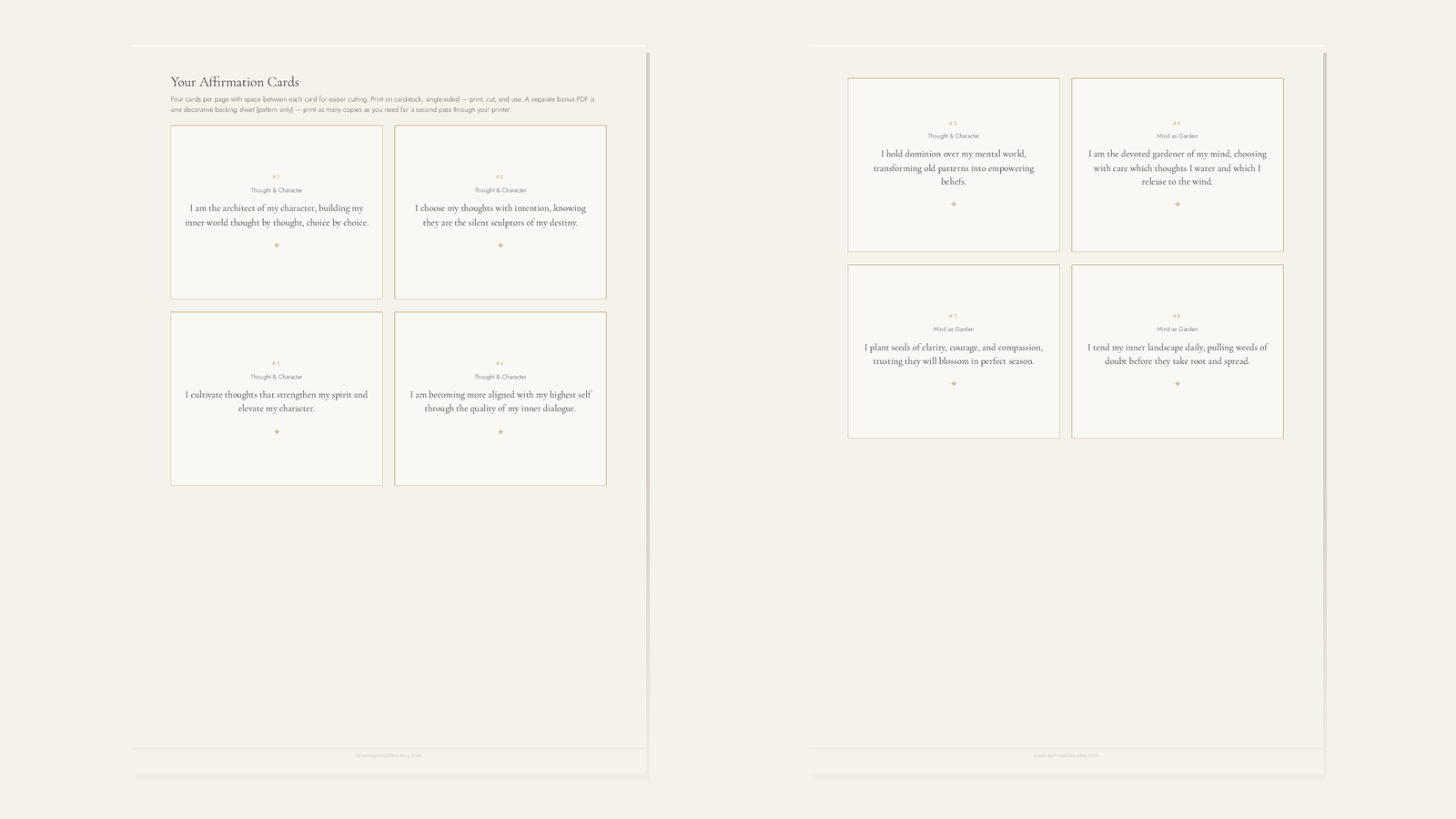
50 printable cards built from Allen's teaching on character and thought - designed as identity-level statements, not surface affirmations, because that is what Allen meant by 'the heart.' Pull one daily to prime at the level that actually produces change.
A look inside
What you get
The Method
Why cards work when a book does not
Reading a book is a single linear encounter. You move through it once, retain a fraction, and rarely return to the passages that most needed to land. A card deck removes the sequence entirely. You encounter the same principles in shifting order across days and weeks, which prevents the habituation that kills impact in linear reading. The principle you dismissed on Monday draws your hand on Thursday when your situation has changed enough to receive it.
Physical handling activates different neural processing than reading on a screen. The act of shuffling, drawing, and holding a card engages embodied cognition - the brain processes meaning differently when the hands are involved. Each card is designed to be read slowly, held for a moment, and felt as well as understood.
Single-card focus is also a concentration tool. When you draw one card and sit with it for the day, you are practising the interior direction Allen describes throughout As a Man Thinketh: sustained attention on one idea, long enough for it to pass from the conscious surface into the subconscious field where change actually happens.
How to Use It
Four ways to work with the deck
Daily draw
Shuffle, draw one card at the start of the day. Place it somewhere visible on your desk. Let it inform the quality of attention you bring to ordinary tasks - not as a to-do but as a lens.
Intention draw
Hold a specific challenge or decision in mind, then draw. The principle you receive is not random - your subconscious guides your hand toward what it already knows you need. Read it in light of the specific question.
Weekly anchor
Draw one card on Sunday evening. Pin it visibly for the week. The principle becomes a background operating instruction - not something you actively think about, but something that subtly colours every interaction for seven days.
Reflection spread
Draw three cards: where I am now, what I am moving toward, what supports the shift. This is a five-minute practice at the end of the week that externalises the subconscious processing that has been happening quietly all along.
Worth knowing
This is a daily practice tool, not a structured programme
The card deck works through repeated, flexible exposure - it is not a step-by-step system. If you want thirty days of structured daily exercises that take you through the teaching methodically, that is what the workbook is built for. The 30-day workbook is here.
Who This Is For
You'll get the most from this if…
- ✓You've read As a Man Thinketh but your circumstances haven't changed
- ✓You believe mindset matters but don't know how to actually change yours
- ✓You want to understand why positive thinking alone doesn't work - and what does
- ✓You're interested in the overlap between Victorian self-help and modern CBT
- ✓You're building discipline and character rather than chasing quick manifestation
- ✓You want a daily practice that makes Allen's principles concrete and measurable
Complete the Practice
Complete the As a Man Thinketh practice
Quick-Start Cheat Sheets
The core principles across multiple printable pages.
30-Day Challenge Workbook
Build the teaching into 30 days of structured daily practice.
Habit Tracker & Goal Planner
Track the micro-habits that compound into lasting change.
52-Week Daily Affirmation Calendar
52 weeks of daily affirmations - one for every day from May 2026 to April 2027.
The Toolkit
All five products for this work in one discounted bundle. Save 30%.
Annotated Edition
Christie L. Russell's annotated edition with neuroscience and NLP commentary.
About the Work
As a Man Thinketh - New Thought, 1864-1912
One of the most widely read self-development texts ever written, arguing that thought is the master weaver of character, circumstance, and destiny. The entire premise of modern CBT is in this book - written decades before cognitive therapy was named.
The Science Behind It
'As a man thinketh in his heart, so is he' is a premodern description of what cognitive behavioural therapy calls the cognitive triad: thoughts drive feelings, feelings drive behaviour, behaviour shapes circumstance. Allen was describing the CBT loop a century before Aaron Beck codified it. The phrase 'in his heart' is the key distinction - he wasn't talking about surface-level positive thinking but about the deeply held beliefs that operate below conscious awareness, which is exactly what CBT and NLP target.
Want to be first to know when new products launch?
Join the list - get the free workbook too →