
Track the micro-habits that compound into lasting change.
Habit Tracker & Goal Planner
As a Man Thinketh
Apply the Teaching
Habit Tracker & Goal Planner for As a Man Thinketh
As a Man Thinketh - 90-Day Habit Tracker
Character is built in daily repetitions, not insights. 90 days of structured tracking for the habits Allen identifies - thought direction, mental weeding, purposeful action - with enough container to make them stick.
A look inside
What you get
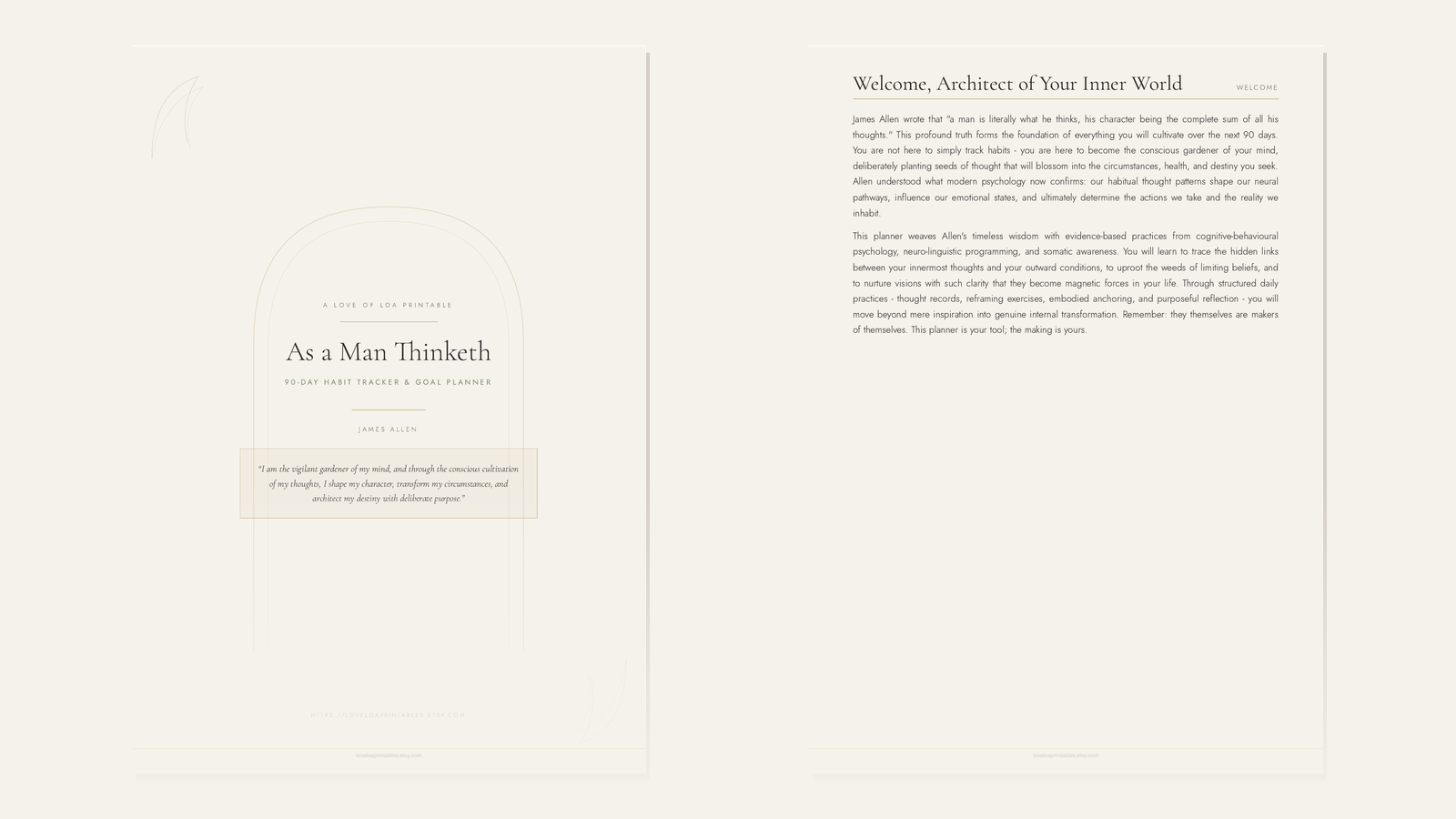
Inside the Tracker
90 days of practice, visible on one page
Daily check-in grid
90 consecutive days in a single view. Each row is a habit drawn from Allen’s principles. Each column is a day. A single mark takes five seconds.
Weekly reflection prompt
One question at the end of each week that connects your pattern data to the principle behind it. Not journalling - a single, targeted observation.
30-day milestone markers
The grid marks days 30 and 60 visually. Each is a natural review point - not a restart, but a moment to assess what has shifted and what needs more attention.
Print-ready A4
Designed to pin where you will see it daily. The visual presence of a near-complete row is one of the strongest natural motivators available.
The Method
What you measure, you manage - and what you see, you protect
Self-monitoring is one of the most robust behaviour-change mechanisms in the clinical literature. Simply tracking a behaviour - without any other intervention - produces measurable improvement in consistency. This is the Hawthorne effect in practice: awareness changes behaviour. The tracker externalises what was previously invisible.
The visual streak is a second mechanism. A row of marks on a habit grid creates what behavioural economists call sunk-cost motivation - the useful kind, where an unbroken streak becomes worth protecting for its own sake. Visual continuity sustains behaviour past the point where motivation alone would have collapsed.
The 90-day window spans three complete 30-day cycles - enough time to see a genuine pattern change emerge, not just a good week. After 90 days, the habits that have stuck are now default behaviours. The ones that have not reveal where the underlying belief work is still needed - which is where the workbook comes in.
How to Use It
Simple by design
- 1
Print and pin visibly
The tracker only works if you see it every day. Kitchen wall, bathroom mirror, beside the desk - somewhere it is unavoidable. Out of sight is out of practice.
- 2
Mark at the end of the day
Evening marking creates a brief daily review - did I do the thing? - which is itself a form of self-monitoring that reinforces the behaviour you tracked.
- 3
Never miss twice in a row
Missing one day is a data point. Missing two days in a row is the start of a new pattern. The research on habit maintenance consistently shows that the second miss is more destructive than the first. Missing once is human. Missing twice is a decision.
- 4
Use day 30 and day 60 as honest review points
Look at the full pattern, not individual days. Which habits have high consistency? Which have a pattern of misses on specific days or weeks? That pattern is information - it shows you where the belief work still needs to happen.
Worth knowing
This tracks the practice - it does not teach it
The tracker assumes you know what the habits mean and why they matter. If you want the full 30-day guided system that explains the principles, builds the exercises, and takes you through the belief work underneath each habit, that is what the workbook is for. The 30-day workbook is here.
Who This Is For
You'll get the most from this if…
- ✓You've read As a Man Thinketh but your circumstances haven't changed
- ✓You believe mindset matters but don't know how to actually change yours
- ✓You want to understand why positive thinking alone doesn't work - and what does
- ✓You're interested in the overlap between Victorian self-help and modern CBT
- ✓You're building discipline and character rather than chasing quick manifestation
- ✓You want a daily practice that makes Allen's principles concrete and measurable
Complete the Practice
Complete the As a Man Thinketh practice
Quick-Start Cheat Sheets
The core principles across multiple printable pages.
30-Day Challenge Workbook
Build the teaching into 30 days of structured daily practice.
52-Week Daily Affirmation Calendar
52 weeks of daily affirmations - one for every day from May 2026 to April 2027.
Affirmation Card Deck
52 cards to carry the teaching into every part of your day.
The Toolkit
All five products for this work in one discounted bundle. Save 30%.
Annotated Edition
Christie L. Russell's annotated edition with neuroscience and NLP commentary.
About the Work
As a Man Thinketh - New Thought, 1864-1912
One of the most widely read self-development texts ever written, arguing that thought is the master weaver of character, circumstance, and destiny. The entire premise of modern CBT is in this book - written decades before cognitive therapy was named.
The Science Behind It
'As a man thinketh in his heart, so is he' is a premodern description of what cognitive behavioural therapy calls the cognitive triad: thoughts drive feelings, feelings drive behaviour, behaviour shapes circumstance. Allen was describing the CBT loop a century before Aaron Beck codified it. The phrase 'in his heart' is the key distinction - he wasn't talking about surface-level positive thinking but about the deeply held beliefs that operate below conscious awareness, which is exactly what CBT and NLP target.
Want to be first to know when new products launch?
Join the list - get the free workbook too →