
The core principles across multiple printable pages.
Quick-Start Cheat Sheets
As a Man Thinketh
Apply the Teaching
Quick-Start Cheat Sheets for As a Man Thinketh
As a Man Thinketh - Quick-Start Cheat Sheets
Allen's framework at a glance - the thought-character link, how to weed limiting beliefs, and what the connection between habitual thinking and circumstance means in practice. A fast-scan reference for the days you need his teaching in seconds, not a re-read.
A look inside
What you get
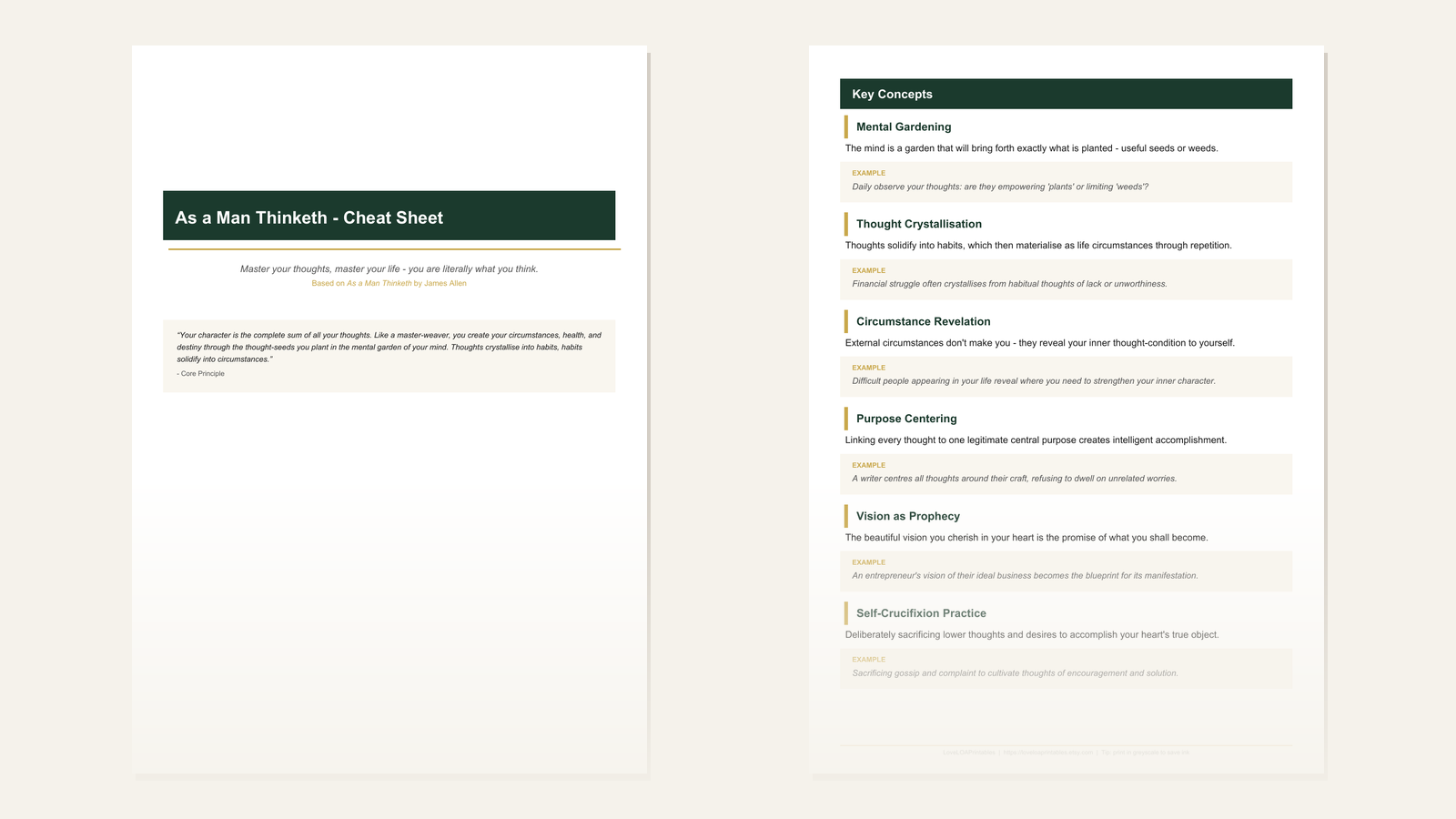
Inside the Cheat Sheets
One page per core principle
Thought and character are one
Allen's foundational claim is not motivational - it is architectural.
Circumstances reveal - they do not make
Allen's most quoted and most misread line: 'Circumstances do not make the man, they reveal him.' He is not saying your circumstances are your fault.
The mind is a garden
Allen's most practical image: the mind is a garden you can either intelligently cultivate or allow to run wild.
The body and the mind are in constant conversation
Allen wrote Chapter 3 - on the effect of thought on health - in 1903.
Purpose is the axis everything else turns on
Allen argues that without a clearly held purpose, mental energy dissipates.
Serenity is a measurable outcome, not a personality trait
The final chapter is often read as a reward for the work.
The Method
CBT, NLP and somatic principles built into every line
Every line on the cheat sheets is written in NLP presupposition structure - language that treats the principle as already true rather than something to aspire toward. This is not a stylistic choice; it is a functional one. The subconscious mind processes language that presupposes reality more readily than language that frames it as a goal. “Your attention filter is already working for you” lands differently than “try to change your attention filter.”
The layout applies CBT chunking principles: each principle sits in its own distinct block so the brain processes it as a discrete unit rather than as part of an undifferentiated wall of text. Cluttered reference material is processed as noise. Clean, spaced, visually distinct content is processed as signal. The design decisions are functional, not decorative.
Printed and placed visibly, the cheat sheets work as environmental priming - a principle from somatic psychology. What you see repeatedly, without actively reading, shapes your default perceptual set. A cheat sheet pinned above your desk works not only when you read it deliberately but when your peripheral vision catches it during ordinary work. The subconscious is always receiving.
Why we built it this way
We applied CBT schema restructuring, NLP submodality work, and somatic nervous system regulation to As a Man Thinketh. The goal was to build tools that reach the level Allen called 'the heart' - the below-conscious belief layer where habitual patterns actually live.
The workbook, cheat sheets, tracker, and card deck below are built around that premise. Surface-level repetition is not enough. Change at depth requires reaching the level where beliefs are encoded - which is why each tool combines Allen's principles with the body-based techniques that make those principles land rather than bounce.
How to Use It
Three uses that actually work
- 1
Print and pin visibly
Pin the pages where you will see them without actively looking - above your desk, on the kitchen wall, beside the mirror. Peripheral exposure is the mechanism. You do not need to read it every day; you need it in your visual field.
- 2
Scan before a decision or challenge
Before a difficult conversation, a business decision, or a moment when the old pattern is likely to activate - read one principle deliberately. A 90-second scan primes the attentional filter before it is tested.
- 3
Use as a nightly anchor
The pre-sleep window is the subconscious's most receptive state. Reading one principle immediately before sleep is the highest-leverage moment in the day for impressing a new pattern. Two minutes - one principle, read slowly, felt rather than just processed.
Worth knowing
This is a reference tool, not a practice system
The cheat sheets give you the principles in a scannable, always-available format. They will not give you thirty days of structured daily practice - that is what the workbook is built for. If you want the 30-day practice system, it is here.
Who This Is For
You'll get the most from this if…
- ✓You've read As a Man Thinketh but your circumstances haven't changed
- ✓You believe mindset matters but don't know how to actually change yours
- ✓You want to understand why positive thinking alone doesn't work - and what does
- ✓You're interested in the overlap between Victorian self-help and modern CBT
- ✓You're building discipline and character rather than chasing quick manifestation
- ✓You want a daily practice that makes Allen's principles concrete and measurable
Complete the Practice
Complete the As a Man Thinketh practice
30-Day Challenge Workbook
Build the teaching into 30 days of structured daily practice.
Habit Tracker & Goal Planner
Track the micro-habits that compound into lasting change.
52-Week Daily Affirmation Calendar
52 weeks of daily affirmations - one for every day from May 2026 to April 2027.
Affirmation Card Deck
52 cards to carry the teaching into every part of your day.
The Toolkit
All five products for this work in one discounted bundle. Save 30%.
Annotated Edition
Christie L. Russell's annotated edition with neuroscience and NLP commentary.
About the Work
As a Man Thinketh - New Thought, 1864-1912
One of the most widely read self-development texts ever written, arguing that thought is the master weaver of character, circumstance, and destiny. The entire premise of modern CBT is in this book - written decades before cognitive therapy was named.
The Science Behind It
'As a man thinketh in his heart, so is he' is a premodern description of what cognitive behavioural therapy calls the cognitive triad: thoughts drive feelings, feelings drive behaviour, behaviour shapes circumstance. Allen was describing the CBT loop a century before Aaron Beck codified it. The phrase 'in his heart' is the key distinction - he wasn't talking about surface-level positive thinking but about the deeply held beliefs that operate below conscious awareness, which is exactly what CBT and NLP target.
Want to be first to know when new products launch?
Join the list - get the free workbook too →