Build the teaching into 30 days of structured daily practice.
30-Day Challenge Workbook
The Science of Getting Rich
Apply the Teaching
30-Day Challenge Workbook for The Science of Getting Rich
The Science of Getting Rich - 30-Day Challenge Workbook
You've read the book. This is where the shift actually happens - 30 structured days that build the 'certain way' as a default mental state, not just a concept you revisit when things go wrong.
The Science of Getting Rich - 30-Day Digital Workbook
All 30 days of Wattles' certain-way practice designed for GoodNotes, Notability, and any PDF app. The same structured exercises on your tablet - no printing needed.
The Science of Getting Rich - 30-Day Fillable Workbook
The full 30-day certain-way programme with fillable form fields - type directly in any PDF reader, no printing required, no app needed.
A look inside
What you get
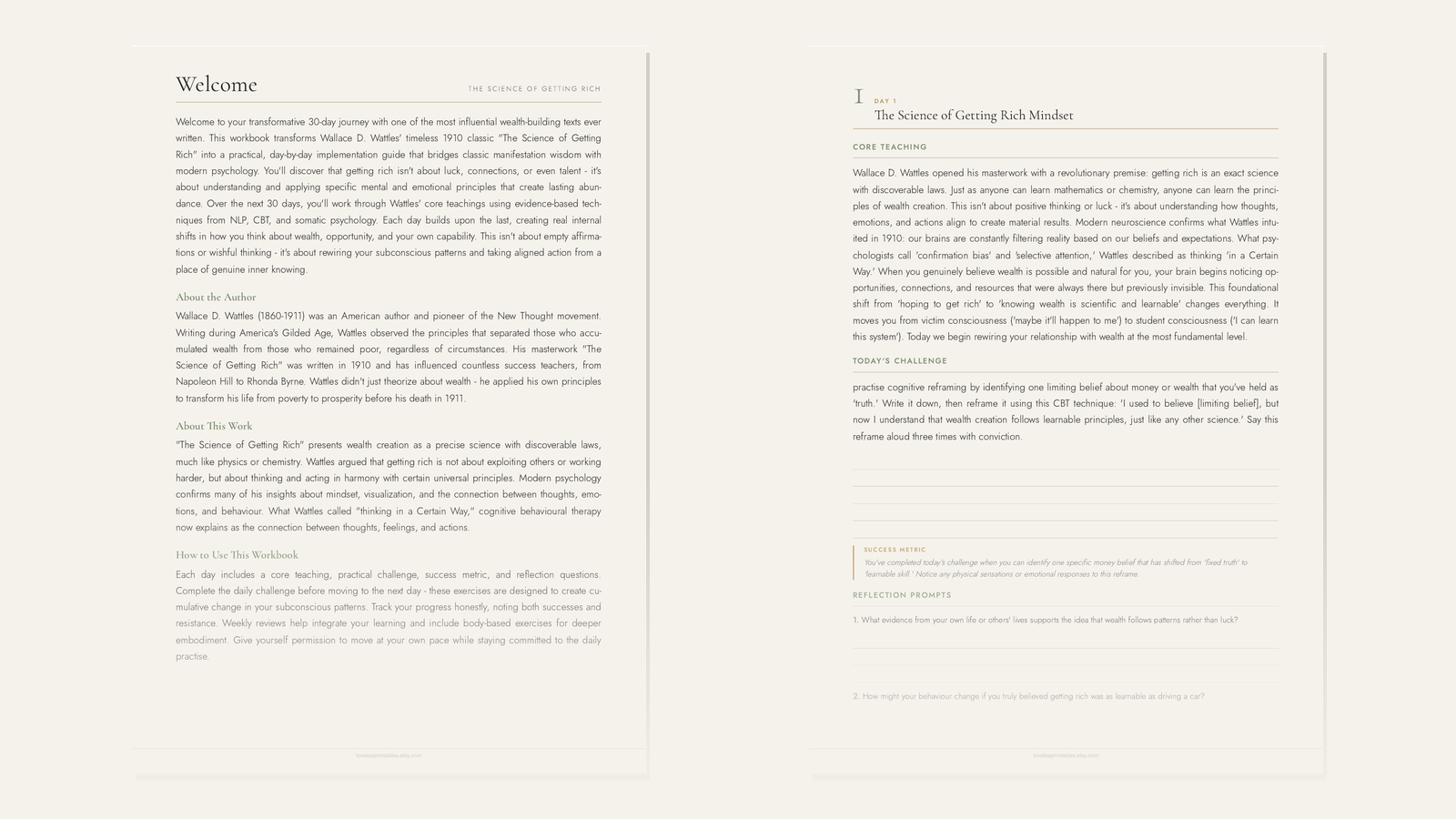
Inside the Workbook
30 days through every section of The Science of Getting Rich
1 - The Right to Be Rich
Wattles opens with a declaration: wanting to be rich is not greedy or shameful - it is the natural desire to fully live, and suppressing it is a form of under-living.
2 - There Is a Science of Getting Rich
Wealth follows exact principles. Anyone who learns and applies them can get rich, regardless of talent, environment, or luck.
3 - Is Opportunity Monopolized?
Opportunity is not controlled by those who already have wealth. The creative mind finds opportunity wherever it looks; the competitive mind sees none.
4 - The First Principle in the Science of Getting Rich
The foundational principle: thought is causative. Everything that exists in the physical world began as a thought held in creative mind.
5 - Increasing Life
The purpose of wealth is to increase life - yours and others'. Every interaction should leave people feeling advanced, not diminished.
6 - How Riches Come to You
Riches come through people, not around them. The creative person attracts the right people and opportunities by consistently providing the impression of increase.
7 - Gratitude
Gratitude is not sentiment - it is the daily practice that keeps the mind in the creative state and closes the circuit between desire and reception.
8 - Thinking in the Certain Way
How to hold the mental image of what you want with clear vision and settled faith - not desperate wanting, but certain knowing.
9 - How to Use the Will
The will is not for forcing outcomes; it is for directing your own attention. Use it on yourself, not on circumstances or other people.
10 - Further Use of the Will
Never think about poverty, lack, or limitation - not as denial, but because dwelling on what you do not want directs the formless substance toward more of the same.
11 - Acting in the Certain Way
Thought is the cause; action is the vehicle. Act every day - do all that can be done today - but act from the creative state, not from competitive anxiety.
12 - Efficient Action
Efficiency is not speed; it is doing each thing you do with full focus and complete intention. Every act performed in this way builds the habit of creative action.
13 - Getting into the Right Business
Do work you are genuinely suited for. Friction between your nature and your work drains the creative energy that wealth creation requires.
14 - The Impression of Increase
Everyone you meet should feel better for having encountered you. The impression of increase is the lived expression of creative thought and the engine of lasting influence.
15 - The Advancing Person
The person who is becoming more is always advancing - expanding capacity, deepening vision, increasing service. There is no standing still; there is only advance or retreat.
16 - Some Cautions and Concluding Observations
Practical guardrails: avoid the competitive mindset in all its forms, don't separate the mental work from the physical action, and never mistake inspired feeling for completed work.
17 - Summary of the Science of Getting Rich
Wattles condenses the entire system into its essential sequence: hold the clear mental image, maintain gratitude, act efficiently, advance consistently.
The Method
Reading the book and doing the work are not the same thing
Most people read Wattles's work, agree with it entirely, and then continue doing what they have always done. The gap is not understanding - it is practice. Understanding what the mind needs and consistently doing the work to give it that are two different capacities, and only one of them produces change.
Every exercise in the workbook is built on that distinction. CBT-style thought records identify the specific belief structure underneath a recurring pattern and interrupt it precisely. NLP timeline and future-pacing exercises take a principle from abstract understanding to felt, embodied rehearsal. Somatic check-ins anchor each session in the body rather than the head, because the subconscious communicates through physical sensation, not just through reasoning.
The 30-day structure is deliberate. Habit formation research puts the minimum threshold for a new behaviour to feel natural at 21-66 days, depending on complexity. 30 days sits at the lower end with a full review cycle - enough repetition to shift a default, not so long that momentum collapses before you finish.
How to Use It
Four things that make the difference
- 1
Print it and write by hand
Handwriting activates deeper processing than typing. The motor memory of physically writing a belief, a response, or an intention encodes it differently than keystrokes. Print the workbook and use a pen - it is a functional difference, not a stylistic preference.
- 2
Same time every day
Link the practice to an existing anchor - immediately after your first coffee, or the last thing before sleep. Habit stacking removes the daily decision of whether to do it. The decision is already made.
- 3
Do not skip the body check-in
The somatic prompts at the start of each session are the most skippable-looking part and the most important. What your body is holding at the moment you begin determines how deeply the exercises land. Two minutes of physical grounding before cognitive work changes the quality of everything that follows.
- 4
If you miss a day, continue from where you stopped
Do not restart. Restarting from day one after a miss turns the workbook into a test of willpower rather than a practice tool. The sequence builds on itself - day 15 is more useful after days 1-14, even with gaps.
Worth knowing
This is a practice system, not a reference tool
The workbook takes you through 30 days of structured exercises - it is not designed for quick reference or scanning. If you want the principles in a format you can pin up and return to in 30 seconds, that is what the cheat sheets are for. The cheat sheets are here.
Who This Is For
You'll get the most from this if…
- ✓You've read The Science of Getting Rich but are still trading time for money
- ✓You want to understand why creative thought works neurologically - not just spiritually
- ✓You're building a business and want to move from scarcity thinking to abundance strategy
- ✓You've tried visualisation but keep taking frantic, fear-driven action instead of efficient action
- ✓You want daily practices that shift your nervous system out of competitive threat mode
- ✓You're drawn to Wattles' systematic approach and want a structured method, not vague inspiration
Complete the Practice
Complete the The Science of Getting Rich practice
Quick-Start Cheat Sheets
The core principles across multiple printable pages.
Habit Tracker & Goal Planner
Track the micro-habits that compound into lasting change.
52-Week Daily Affirmation Calendar
52 weeks of daily affirmations - one for every day from May 2026 to April 2027.
Affirmation Card Deck
52 cards to carry the teaching into every part of your day.
The Toolkit
All five products for this work in one discounted bundle. Save 30%.
Annotated Edition
Christie L. Russell's annotated edition with neuroscience and NLP commentary.
About the Work
The Science of Getting Rich - New Thought, 1860-1911
A precise, unapologetic manual for wealth creation through creative thought and systematic action. Wattles argues that there is a science to getting rich - specific principles that, applied consistently, produce results as reliably as physical laws.
The Science Behind It
Wattles' insistence on 'creative thought over competitive thought' maps cleanly onto the neuroscience of abundance vs. scarcity mindset. Chronic competitive or threat-focused thinking keeps the nervous system in sympathetic activation - fight/flight - which literally narrows perception and problem-solving capacity. Creative thought corresponds to the ventral vagal state: safe, open, and generative. His gratitude practice isn't sentiment; it's a nervous system regulation tool that shifts the body out of threat mode and into the state where creative thinking is neurologically possible.
Questions Answered
Questions about the 30-Day Challenge Workbook for The Science of Getting Rich
What does the Science of Getting Rich 30-Day Workbook contain?+
What gap in the original book does the workbook fill?+
How is this different from just reading The Science of Getting Rich?+
Do I need the cheat sheets before starting the workbook?+
What is the difference between the workbook and the 90-day habit tracker?+
What if I keep slipping back into competitive thinking mid-workbook?+
Want to be first to know when new products launch?
Join the list - get the free workbook too →