52 weeks of daily affirmations - one for every day from May 2026 to April 2027.
52-Week Daily Affirmation Calendar
How to Stay Well
Apply the Teaching
52-Week Daily Affirmation Calendar for How to Stay Well
How to Stay Well - 52-Week Daily Affirmation Calendar - May 2026-April 2027
A full year of wellness affirmations from Christian D. Larson's How to Stay Well.
Inside the Calendar
A year of How to Stay Well - one affirmation every day
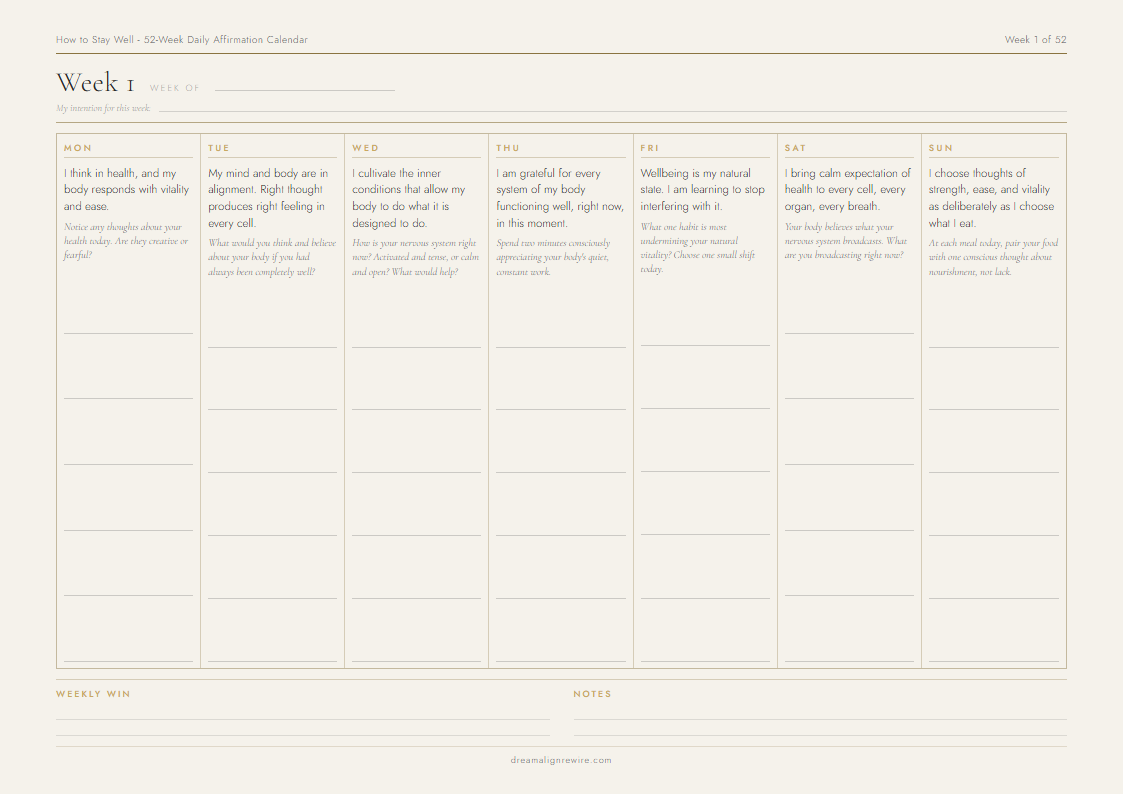
Sample weekly page - A4 format, print at home on plain paper
What's inside
- 365daily affirmations drawn directly from How to Stay Well - one for every day from 1 May 2026 to 30 April 2027
- 52weekly A4 pages, each with a 7-day spread and a short reflection prompt to close the week
- ✓Print-ready PDF - designed for A4, plain white paper, home printer friendly
- ✓Affirmations written in first-person present tense - the NLP-standard format that speaks directly to the subconscious without triggering the critical filter
- ✓Instant download - no shipping, no waiting, start day one today
How to use it
- 1.Print the current week's page and keep it somewhere visible - desk, kitchen worktop, bedside table
- 2.Read the day's affirmation aloud each morning before screens - spoken language primes the subconscious most effectively
- 3.Return to it at night - the state just before sleep is when the subconscious is most receptive to new patterns
- 4.Use Sunday's reflection prompt to note any shifts in thought, mood, or circumstance you noticed during the week
Why daily practice works
Neuroplasticity research confirms that repeated, consistent exposure to a new belief pattern gradually rewires the brain's default processing. A single affirmation session changes nothing; 365 consecutive days of practice - morning and evening - produces measurable change in attentional bias and self-schema. This is why Larson's teaching requires a daily tool, not just a book: reading creates the understanding, but only sustained practice creates the rewire. The calendar makes the commitment visible and the practice frictionless.
Who This Is For
You'll get the most from this if…
- ✓You sense that your physical health is connected to your mental and emotional state but want a framework for understanding how
- ✓You are dealing with stress-related physical symptoms and want tools beyond medication or willpower
- ✓You want to understand the early intellectual history of holistic and integrative medicine
- ✓You have felt trapped in a cycle where anxiety about your health makes the health problem worse
- ✓You are interested in the relationship between emotional states, nervous system regulation, and physical wellbeing
- ✓You want a pre-scientific but intuitively sound framework for the mind-body connection that you can read alongside modern health research
Complete the Practice
Complete the How to Stay Well practice
Quick-Start Cheat Sheets
The core principles across multiple printable pages.
30-Day Challenge Workbook
Build the teaching into 30 days of structured daily practice.
Habit Tracker & Goal Planner
Track the micro-habits that compound into lasting change.
Affirmation Card Deck
52 cards to carry the teaching into every part of your day.
The Toolkit
All five products for this work in one discounted bundle. Save 30%.
Annotated Edition
Christie L. Russell's annotated edition with neuroscience and NLP commentary.
About the Work
How to Stay Well - New Thought, 1866-1954
Larson applies his optimism and mental development principles to physical health, arguing that consistent right thought creates the internal conditions for sustained wellbeing.
The Science Behind It
Larson's prolific optimism-based approach is the closest New Thought comes to positive psychology as a formal discipline. His emphasis on the 'promise yourself' principle maps to self-compassion research - treating yourself as you would a good friend is one of the most evidence-backed interventions for sustained positive change. His insistence on consistency over intensity anticipates what we now know about neuroplasticity: small repeated actions create stronger and more durable neural pathways than occasional dramatic ones.
Want to be first to know when new products launch?
Join the list - get the free workbook too →