52 weeks of daily affirmations - one for every day from May 2026 to April 2027.
52-Week Daily Affirmation Calendar
Your Word is Your Wand
Apply the Teaching
52-Week Daily Affirmation Calendar for Your Word is Your Wand
Your Word is Your Wand - 52-Week Daily Affirmation Calendar - May 2026-April 2027
A full year of spoken word affirmations from Florence Scovel Shinn's Your Word is Your Wand.
Inside the Calendar
A year of Your Word is Your Wand - one affirmation every day
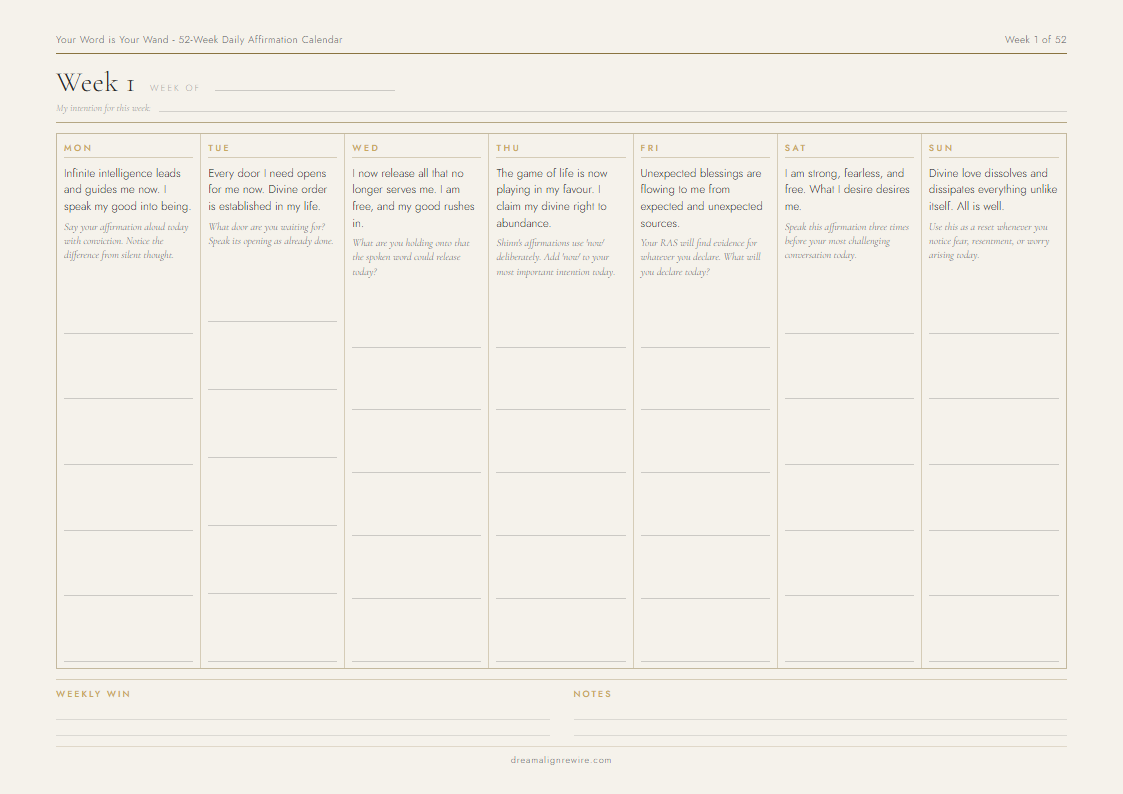
Sample weekly page - A4 format, print at home on plain paper
What's inside
- 365daily affirmations drawn directly from Your Word is Your Wand - one for every day from 1 May 2026 to 30 April 2027
- 52weekly A4 pages, each with a 7-day spread and a short reflection prompt to close the week
- ✓Print-ready PDF - designed for A4, plain white paper, home printer friendly
- ✓Affirmations written in first-person present tense - the NLP-standard format that speaks directly to the subconscious without triggering the critical filter
- ✓Instant download - no shipping, no waiting, start day one today
How to use it
- 1.Print the current week's page and keep it somewhere visible - desk, kitchen worktop, bedside table
- 2.Read the day's affirmation aloud each morning before screens - spoken language primes the subconscious most effectively
- 3.Return to it at night - the state just before sleep is when the subconscious is most receptive to new patterns
- 4.Use Sunday's reflection prompt to note any shifts in thought, mood, or circumstance you noticed during the week
Why daily practice works
Neuroplasticity research confirms that repeated, consistent exposure to a new belief pattern gradually rewires the brain's default processing. A single affirmation session changes nothing; 365 consecutive days of practice - morning and evening - produces measurable change in attentional bias and self-schema. This is why Shinn's teaching requires a daily tool, not just a book: reading creates the understanding, but only sustained practice creates the rewire. The calendar makes the commitment visible and the practice frictionless.
Who This Is For
You'll get the most from this if…
- ✓You understand affirmations intellectually but struggle to make them feel real or produce results
- ✓You want practical, ready-to-use verbal formulas rather than abstract metaphysical theory
- ✓You have tried silent visualisation and found it draining or counterproductive - you want an active, spoken approach
- ✓You have experienced the 'boomerang effect' and want to understand why what you say (and think) keeps coming back to you
- ✓You are drawn to Shinn's blend of spiritual law and practical action, and want to apply it to money, relationships, and work
- ✓You want to understand how Louise Hay's foundational affirmation method was built and where it came from
Complete the Practice
Complete the Your Word is Your Wand practice
Quick-Start Cheat Sheets
The core principles across multiple printable pages.
30-Day Challenge Workbook
Build the teaching into 30 days of structured daily practice.
Habit Tracker & Goal Planner
Track the micro-habits that compound into lasting change.
Affirmation Card Deck
52 cards to carry the teaching into every part of your day.
The Toolkit
All five products for this work in one discounted bundle. Save 30%.
Annotated Edition
Christie L. Russell's annotated edition with neuroscience and NLP commentary.
About the Work
Your Word is Your Wand - New Thought, 1871-1940
A collection of precisely structured affirmations showing how spoken words impress the subconscious and activate creative law. Each affirmation is the presupposition principle made practical.
The Science Behind It
Shinn's 'power of the spoken word' is not mystical - it's a form of linguistic priming. NLP formalised this as the presupposition principle: the brain treats spoken statements as instructions and organises experience to confirm them. Her affirmations work specifically when structured as already-accomplished facts because the subconscious processes language literally, without the qualifications the conscious mind adds. The 'fearlessness' she emphasised maps to what modern therapy calls acting from the window of tolerance - making decisions from a regulated nervous system rather than from fear or avoidance.
Want to be first to know when new products launch?
Join the list - get the free workbook too →