The core principles across multiple printable pages.
Quick-Start Cheat Sheets
Awakened Imagination
Apply the Teaching
Quick-Start Cheat Sheets for Awakened Imagination
Awakened Imagination - Quick-Start Cheat Sheets
Neville's most sophisticated ideas in one printable reference - the Revision technique, the seven chapters mapped to practice, and what it means for imagination to be causal rather than escapist.
A look inside
What you get
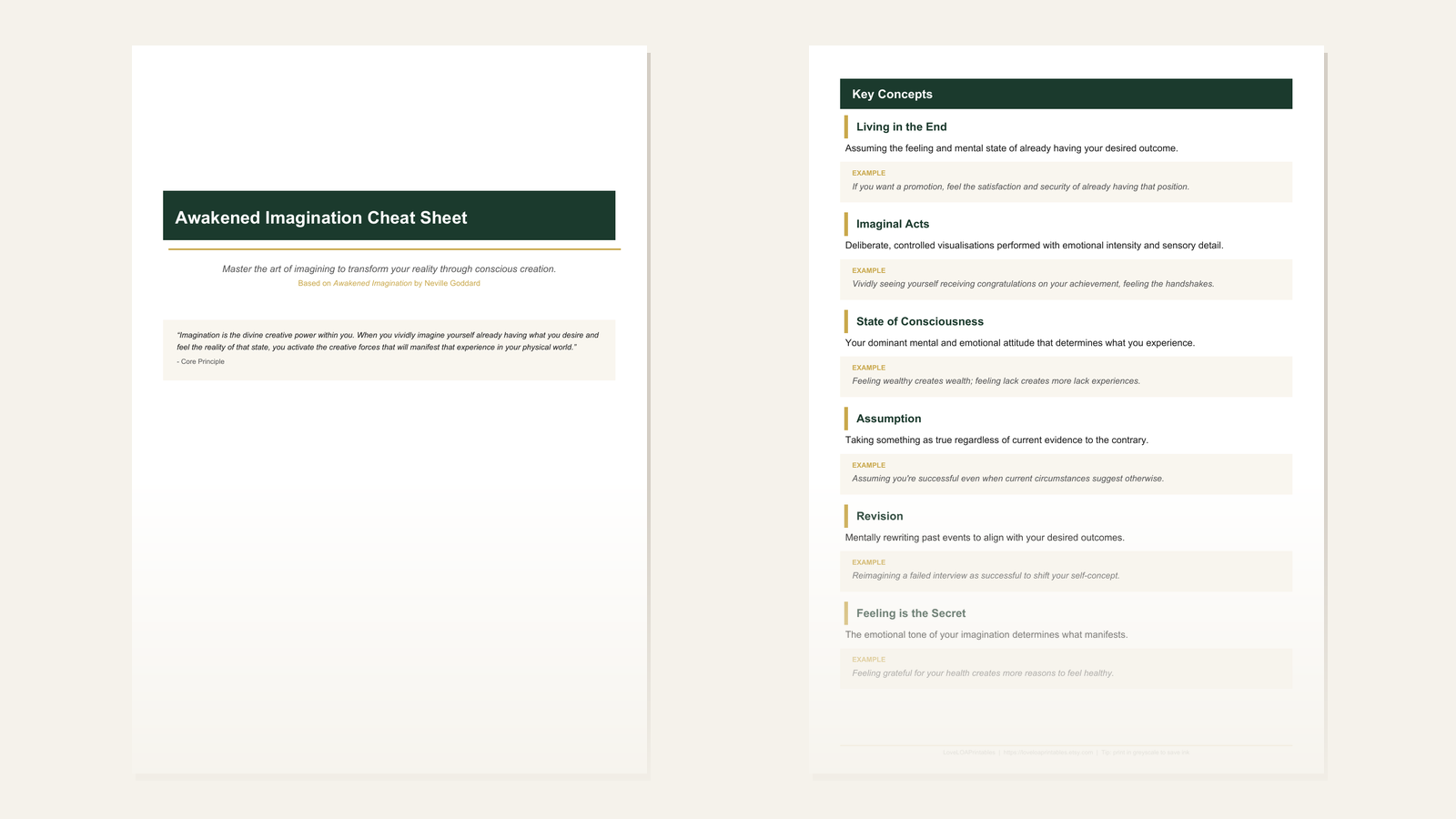
Inside the Cheat Sheets
One page per core principle
Imagination is not fantasy - it is causal reality
The imagination is not a retreat from the real world; it is the reality from which the physical world proceeds.
The imaginal act must be felt, not just pictured
Sensory-vivid imagination that includes the feeling-tone of the wish fulfilled activates the mechanisms that change physical reality.
Revision changes the past
The past is not fixed.
Creation is finished - you are selecting, not creating
All possibilities already exist in what Neville calls the 'infinite within.' What you are doing through assumption is not manufacturing a new reality from nothing but occupying a version of reality that is already complete.
The inner world is the causal world
What happens in imagination is not less real than physical events; it is more fundamental.
Imagination must be awakened, not discovered
The creative power of imagination exists in everyone but lies dormant until deliberately activated.
The Method
CBT, NLP and somatic principles built into every line
Every line on the cheat sheets is written in NLP presupposition structure - language that treats the principle as already true rather than something to aspire toward. This is not a stylistic choice; it is a functional one. The subconscious mind processes language that presupposes reality more readily than language that frames it as a goal. “Your attention filter is already working for you” lands differently than “try to change your attention filter.”
The layout applies CBT chunking principles: each principle sits in its own distinct block so the brain processes it as a discrete unit rather than as part of an undifferentiated wall of text. Cluttered reference material is processed as noise. Clean, spaced, visually distinct content is processed as signal. The design decisions are functional, not decorative.
Printed and placed visibly, the cheat sheets work as environmental priming - a principle from somatic psychology. What you see repeatedly, without actively reading, shapes your default perceptual set. A cheat sheet pinned above your desk works not only when you read it deliberately but when your peripheral vision catches it during ordinary work. The subconscious is always receiving.
Why we built it this way
The Awakened Imagination tools are built around two things the book does not supply: a safe, structured entry into the imaginal state for bodies that are not already calm, and a Revision protocol with preparation steps that make it accessible for deeper material. The 30-day workbook addresses both - building imaginal fluency gradually before applying it to charged material, and giving specific body-based preparation before any Revision practice.
The imagination-as-creative-cause premise - which is the most important idea in the book - needs to be felt rather than understood. That is what the card deck and habit tracker do: they give daily micro-practices that build imaginal fluency through repetition, so that vivid deliberate imagination becomes a skill rather than an occasional peak experience. A fluent imaginal practice is the foundation from which Revision, SATS, and assumption all work more reliably.
How to Use It
Three uses that actually work
- 1
Print and pin visibly
Pin the pages where you will see them without actively looking - above your desk, on the kitchen wall, beside the mirror. Peripheral exposure is the mechanism. You do not need to read it every day; you need it in your visual field.
- 2
Scan before a decision or challenge
Before a difficult conversation, a business decision, or a moment when the old pattern is likely to activate - read one principle deliberately. A 90-second scan primes the attentional filter before it is tested.
- 3
Use as a nightly anchor
The pre-sleep window is the subconscious's most receptive state. Reading one principle immediately before sleep is the highest-leverage moment in the day for impressing a new pattern. Two minutes - one principle, read slowly, felt rather than just processed.
Worth knowing
This is a reference tool, not a practice system
The cheat sheets give you the principles in a scannable, always-available format. They will not give you thirty days of structured daily practice - that is what the workbook is built for. If you want the 30-day practice system, it is here.
Who This Is For
You'll get the most from this if…
- ✓You know the Revision technique exists but have never been walked through it properly
- ✓You've visualised your goals repeatedly and nothing changes - you need to understand why
- ✓You want to use imagination deliberately, not just as occasional daydreaming
- ✓You've been told the past is fixed and want a tool that proves otherwise
- ✓You're ready for the deeper Neville - not just the techniques but the philosophy behind them
- ✓You want a daily practice that builds imaginal fluency rather than occasional peak-state attempts
Complete the Practice
Complete the Awakened Imagination practice
30-Day Challenge Workbook
Build the teaching into 30 days of structured daily practice.
Habit Tracker & Goal Planner
Track the micro-habits that compound into lasting change.
52-Week Daily Affirmation Calendar
52 weeks of daily affirmations - one for every day from May 2026 to April 2027.
Affirmation Card Deck
52 cards to carry the teaching into every part of your day.
The Toolkit
All five products for this work in one discounted bundle. Save 30%.
Annotated Edition
Christie L. Russell's annotated edition with neuroscience and NLP commentary.
About the Work
Awakened Imagination - New Thought, 1905-1972
Neville's most philosophically complete work, arguing that human imagination is not a tool for influencing reality but the causal reality itself. Contains his fullest treatment of the Revision technique - and the 'Creation Is Finished' framework that explains why manifestation is selective rather than random.
The Science Behind It
Neville's 'consciousness is the only reality' maps directly onto what neuroscience calls the Reticular Activating System (RAS) - the brain's filter that only lets in what you're already primed to see. His SATS technique is a structured form of hypnagogic theta-state imprinting: the same window that clinical hypnotherapy exploits because the critical faculty of the conscious mind is suspended. The 'feeling is the secret' insight is confirmed by somatic psychology - emotional states encode beliefs at a body level, not just a cognitive one. This is why affirmations without embodied feeling don't work: you're addressing the wrong part of the system.
Questions Answered
Questions about the Quick-Start Cheat Sheets for Awakened Imagination
What does the Awakened Imagination cheat sheet pack contain?+
What gap does the original book leave that the cheat sheets fill?+
How is this different from just reading the book?+
Do I need to have read the book first?+
What is the difference between the cheat sheets and the 30-day workbook?+
How do I use the Revision Protocol sheet?+
Want to be first to know when new products launch?
Join the list - get the free workbook too →