Imposter Syndrome as a Nervous System Response - What It Actually Is

Imposter syndrome is not a confidence problem. It is not a mindset problem. It is your nervous system doing exactly what it was designed to do - and that changes everything about how you address it.
Key takeaways
- ✦Imposter syndrome is not a sign of inadequacy. It is a threat-detection response - your nervous system flagging visibility as danger based on past experience.
- ✦Polyvagal theory explains why 'fake it til you make it' does not work. You cannot think your way out of a physiological state.
- ✦In Human Design, Channel 16-48 is literally wired for depth before expression - Gate 48 (fear of inadequacy) and Gate 16 (skilled expression) are in the same circuit. The fear is part of the design.
- ✦People with this channel often feel completely ready in private, and freeze when expression becomes public. This is not weakness. It is physiology.
- ✦The solution is not courage. It is calming the threat response so that the depth in Gate 48 can travel through Gate 16 and actually reach expression.
You know you have it in you.
That is not arrogance. That is just an honest read of your own capability. You have the experience. You have the knowledge. In conversation, when you are relaxed and with the right people, it flows - the ideas, the clarity, the confidence. You are good at this and some part of you has always known it.
And yet.
There are good days. Days when you sit down and the words come, the work goes out, the response lands well, and you think: there it is. That is what I knew I was capable of. Those days feel like proof that you have finally moved past whatever it was that was holding you back.
And then it stops again. Not because anything has changed. Not because the feedback was bad or the idea ran out. Something shifts and the version of you that had full access to everything you know simply is not there today. The post sits in drafts. The email does not get sent. The thing you built sits on your hard drive because you cannot quite make yourself put it out there. You know exactly what you need to do and you cannot make yourself do it, and you cannot explain why - not in any way that would make sense to someone else.
This is the pattern that is hardest to live with. Not the bad days in isolation - those you could cope with. It is the fact that you cannot get to consistent. The good days prove you can. The bad days take it back. And nothing you have tried has bridged that gap for long.
Many people at this point have wondered whether it might be ADHD - specifically the inattentive kind, where the profile is exactly this: capable, intelligent, inexplicably unable to convert knowing into doing, with a pattern of good days and bad days that makes no logical sense. If that resonates, it is worth exploring. But this post is about a specific pattern that often sits underneath or alongside ADHD, and sometimes gets mistaken for it entirely. A pattern that is not primarily about attention or executive function, but about what happens in the body when visibility - being seen, being judged, putting your work into the world - starts to feel like a threat.
Because that is what this is. Not a confidence problem. Not a character flaw. Not evidence that you are not as capable as you thought.
Your nervous system has decided that expression is dangerous. And it is doing exactly what it was designed to do about that.
Once you understand that, the inconsistency stops being a mystery.
Why the Standard Advice Does Not Work
The most common advice at this point is essentially a more sophisticated version of "fake it til you make it." Journal your evidence of competence. Remind yourself of your wins. Acknowledge the cognitive distortion and choose a new thought. On a good day, some of this helps. On a bad day, it changes nothing. And it cannot explain why the gap between those two days exists at all.
These approaches are not wrong. Cognitive reframing has a solid evidence base. But they all work at the level of the conscious mind - and imposter syndrome is not a conscious mind problem.
The threat response runs faster and deeper than cognitive thought. When your nervous system reads a situation as dangerous - being visible, being judged, being evaluated by other people - it does not wait for your prefrontal cortex (the brain's rational thinking centre) to weigh in. It activates the same chain of physical responses it would if a car were coming at you.
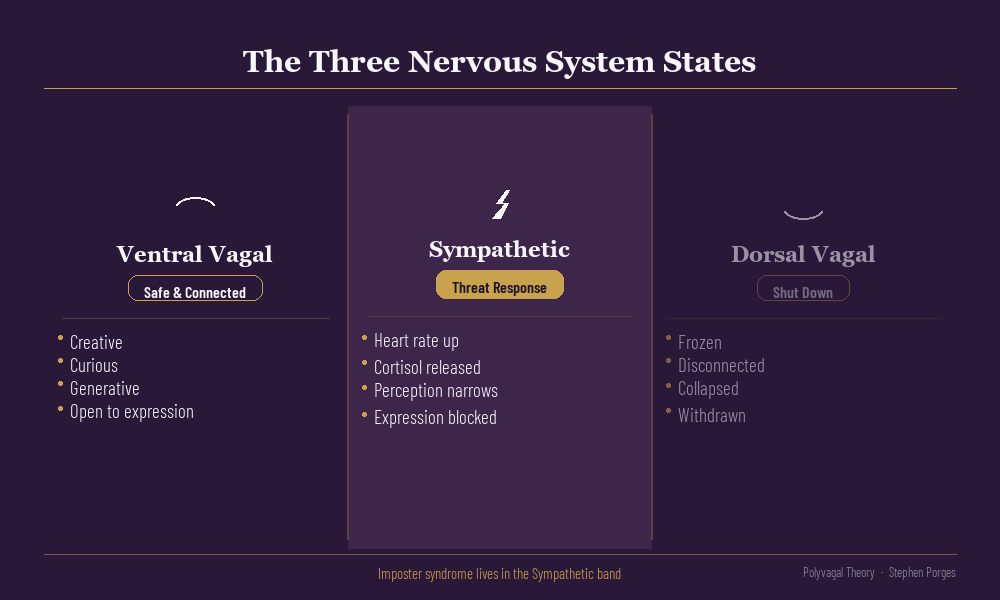
Heart rate up. Cortisol and adrenaline released. Attention narrows. Higher cognitive functions - creativity, nuance, the sense of having something valuable to say - go offline.
By the time you are sitting at your desk with your hand hovering over the publish button, the threat response is already running. Choosing a new thought on top of that physiological state is like trying to reason with someone mid-panic attack. The body is not listening to the mind at that moment.
Stephen Porges' polyvagal theory - the science of how the nervous system shifts between states depending on how safe it perceives the situation to be - describes three of those states: ventral vagal (safe and connected - this is where creativity, curiosity, and genuine expression live), sympathetic (activated for threat - fight or flight, where your heart races and your thinking narrows), and dorsal vagal (shut down and withdrawn - the freeze response). Visibility tends to land in the sympathetic band for people with this pattern. The result is not cowardice. It is physiology.
Free checklist
The Nervous System Reset Checklist
A free one-page guide to the four calming techniques that work fastest for visibility-related threat responses - including the one I use before every piece of public-facing work. Free when you join the list.
Get the free downloadImposter Syndrome as a Nervous System Pattern
Therapist Annie Wright has written clearly about the nervous system patterns behind imposter syndrome - and while the word "trauma" can feel too large for some people's experience, the mechanism she describes is precise.
The nervous system learns. It learns through repeated experience what is safe and what is dangerous. If being visible, being "too much," or being evaluated were genuinely unsafe at some point in your history - criticism that had real consequences, humiliation with social costs, environments where excellence attracted punishment rather than reward - the nervous system files visibility under "threat."
It does not update that filing just because the context has changed. You can be a 45-year-old woman with a solid body of work, a decade of professional credibility, and real results behind you - and your nervous system may still be running the threat assessment it learned in a classroom in 1993.
This is not irrational. It is your nervous system doing its job. The job is protection, and it is very good at that job.
The problem is that the protection is no longer proportionate to the actual danger - and it has become expensive.
What Human Design Adds to This
Here is where it gets specific in a way I find genuinely useful - particularly if you know your Human Design chart.
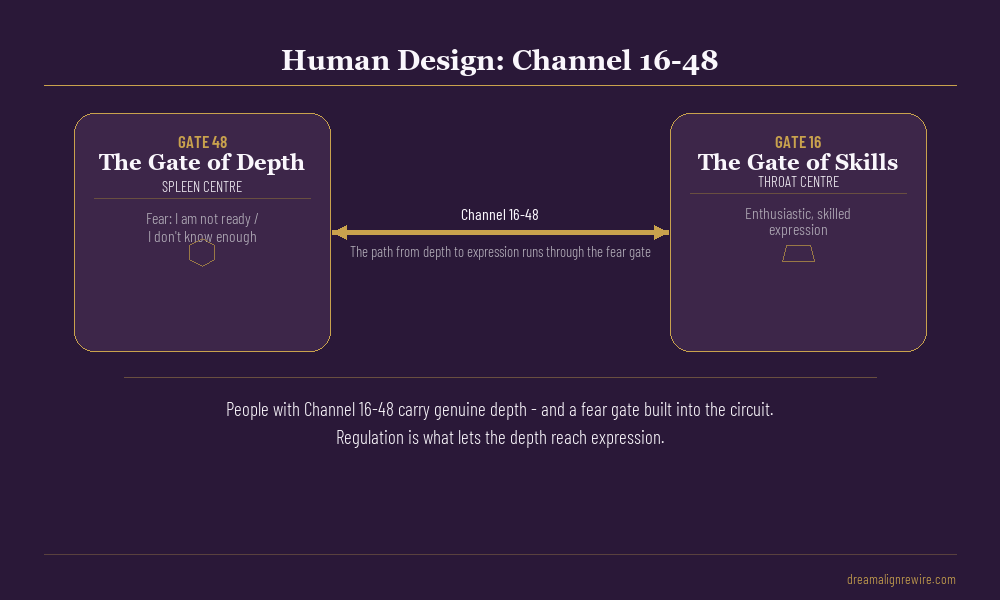
Channel 16-48 connects two gates: Gate 48 (the Gate of Depth) in the Spleen centre, and Gate 16 (the Gate of Skills) in the Throat centre.
Gate 48 is one of the fear gates of the Spleen. Its fear is inadequacy - the persistent sense of not knowing enough, not being ready, not having sufficient depth to justify speaking. People who have Gate 48 in their chart tend to be people of genuine, accumulated depth. They do not stop learning. They are rarely satisfied that they have arrived. They hold considerably more knowledge than they give themselves credit for, and they consistently underestimate their own expertise.
Gate 16 is the gate of skilled expression - enthusiasm, talent, the capacity to express what you know in a way that actually lands for other people. It sits in the Throat centre, which in Human Design is the centre of expression and manifestation.
Channel 16-48, when complete, is the channel of depth expressing through skill. The potential it carries is genuinely significant. But the circuit runs through that Spleen fear gate first.
In plain terms: the path from what you know to being able to express it runs directly through "but what if I am not ready yet?" That fear is not an obstacle to the channel. It is built into the circuit design.
I have Channel 16-48 in my own Human Design chart. I have spent a significant portion of my professional life knowing things I was not sharing, because the nervous system threat response arrived before the expression ever did. The conventional advice in Human Design circles - "trust your depth and share anyway" - I tried. What actually shifted was not an act of courage. It was calming the nervous system.
You do not need the full channel to recognise yourself here
You might have only one of the two gates - which in Human Design is called a hanging gate. One side of the circuit is active in your chart; the other is not. Rather than a consistent, complete channel, you have a gate looking for completion.
If you have Gate 48 alone, you carry the depth and the fear without the consistent drive to express it. The sense of not being ready can feel ever-present, without the corresponding pull toward putting things out there. If you have Gate 16 alone, you have the capacity for enthusiastic, skilled expression - but the depth feels unreliable. Sometimes it is fully there. Other times it is simply not available.
Gates also appear differently depending on where they sit in your chart. A conscious gate (shown in black on most charts, on the Personality side) tends to show up as a trait you recognise in yourself - something you can name and work with. An unconscious gate (shown in red, on the Design side) operates more automatically, beneath your awareness. If Gate 48 is unconscious in your chart, the fear of inadequacy may not announce itself as fear. It may simply feel like something vague and nameless stopping you - a certainty that you are not ready, with no clear reason attached.
The person who switches it on
If you have a hanging gate, something else happens that explains a great deal about inconsistency. When you are around someone who has the gate you are missing, they can temporarily complete the circuit for you. The channel activates. Suddenly the depth is accessible, or suddenly the expression flows, in a way it does not when you are on your own.
This is the electromagnetic connection Human Design describes between people - and it is why certain relationships feel like they open something in you that goes quiet when those people are not around.
If you have an open (undefined) Spleen centre, this goes further. An open centre takes in and amplifies the energy of anyone nearby who has that centre defined. If your Spleen is open and you spend time around someone with Gate 48 defined, you will feel that fear of inadequacy even more acutely than someone who has the gate in their own chart. If your Throat centre is open and you are around someone with Gate 16, expression can suddenly feel available in a way it simply is not when you are alone.
This is why the good-day, bad-day pattern can feel so random. It is often not random at all. It is relational - shifting in response to whose energy your chart is picking up, and whether the circuit happens to be completed by the people in your environment that day.
Take it deeper
The 30-Day Rewire Workbook
A structured 30-day workbook for rewiring the beliefs and nervous system patterns that keep you from expressing what you actually know. Built on CBT and NLP, practical enough to use every single day.
Available in the shop
Get the workbookThe Gap Nobody Has Closed
Every Human Design article on Channel 16-48 - including Healing with Hilery's piece on the channel and Vicki Dickson's writing on Gate 48 - gives the same advice: trust your depth and share anyway. This is not wrong. But it treats the Gate 48 fear as a psychological belief to be pushed through, rather than as a physiological state to move through.
The polyvagal literature correctly identifies the nervous system mechanism but does not have the specificity of Human Design - which can tell you whether this pattern is literally wired into your energetic blueprint, rather than purely conditioned.
The imposter syndrome literature, including Wright's trauma-response framing, correctly engages the nervous system piece but misses the Human Design layer - which explains why some people experience this pattern with an intensity and consistency that does not fully respond to standard therapeutic approaches.
Here is what the three pieces together describe:
If you have Channel 16-48, you are genuinely wired for deep acquisition and skilled expression. And you have a Spleen fear gate as part of the circuit that connects them. That fear gate is not a flaw. The depth of Gate 48 is what makes Gate 16's expression worth anything. But the fear response that guards the depth can, under the right conditions - particularly a history of visibility being unsafe - tip into a full polyvagal threat response. And once it does, expression cannot get through regardless of how much depth is present.
The knowledge does not disappear. The skill does not disappear. The body is simply in a state where expression is not possible, because the nervous system has assessed expression as dangerous.
This is why people with this channel often have the same specific experience: completely fluent in private, in preparation, in conversation with people they trust - and the floor drops out the moment expression becomes public.
What Actually Works
If the problem is physiological, the solution has to meet it at the physiological level.
This does not mean you never do cognitive work. The belief layer matters. If you have internalised "visibility is dangerous," that belief needs to be examined and updated, and CBT and NLP both have effective tools for this. But starting with the belief while the body is still in threat state is like painting a wall that is still wet. The paint does not stick.
Calm the body first. Then cognitive reframing. Then expression.
Calming the nervous system - shifting it out of threat mode and back into a state of safety - is not complicated, but it requires practice before it becomes accessible under pressure. The research on calming the body consistently returns to a small set of techniques that produce measurable changes quickly:
- Extended exhale breathing - specifically, exhales longer than inhales activate the parasympathetic nervous system (the body's built-in calming branch, the opposite of fight-or-flight). Four counts in, six counts out. Measurable change in under two minutes.
- Orienting - slowly scanning the room, letting the eyes rest on things rather than darting, registering that the environment is physically safe. This is not a visualisation. It is a signal to the nervous system through the sensory input it trusts.
- Cold water on the wrists and face activates the dive reflex and slows the heart rate. Blunt but effective.
- Bilateral movement - movement that alternates between the left and right sides of the body, like walking with a natural arm swing - helps discharge the threat energy that is looking for a physical outlet.
- Vagal toning - humming, singing, gargling. The vagus nerve (the long nerve that runs from your brain stem down through your throat, heart, and gut - the main highway of the body's calming system) connects directly to the voice box. Vibration in the throat sends a signal along it that tells your body it is safe.
These are not spiritual practices. They are mechanical. They work on the physiology before the mind is involved, which is precisely why they work in moments when cognitive techniques cannot get traction.
Once the body is out of threat mode, even briefly, the window for expression opens. What Gate 48 holds - the depth, the accumulated knowledge, the genuine skill - can travel through the channel to Gate 16 and reach the Throat. Expression becomes possible again.
The Law of Congruence Connection
This maps directly onto the Law of Congruence framework - the three-stage model that underlies the Dream.Align.Rewire method.
The Dream pillar asks: what do you actually want? For most people with this pattern, there is no uncertainty here. The vision is clear. The content exists. They know what they want to build and say. The dream is not the problem.
The Align pillar asks: what does your inner state need to match that vision? This is precisely where imposter syndrome lives. The vision is real, but the nervous system is running a misaligned threat response to the exact thing you are trying to move toward. Alignment here is not affirmation. It is calming the body. It is building genuine physiological safety around the acts of visibility that your nervous system currently reads as danger.
The Rewire pillar asks: how do you make the calm state your new default? Calming the nervous system, practised repeatedly and specifically in the context of visibility, builds new neural pathways over time. What felt dangerous begins to feel, if not safe, then at least manageable. Neuroplasticity - the brain's ability to physically rewire itself based on repeated experience - is not a metaphor. Doing something repeatedly in a new context literally builds new connections in the brain. The Rewire stage is where the pattern actually changes, not through willpower, but through accumulated evidence that your nervous system can update.
Imposter syndrome is not something you overcome once. It is something you work through, repeatedly, until the nervous system has enough new experience to revise its threat assessment.
Free checklist
The Nervous System Reset Checklist
A free one-page guide to the four calming techniques that work fastest for visibility-related threat responses - including the one I use before every piece of public-facing work. Free when you join the list.
Get the free downloadA Different Frame
If you have been treating imposter syndrome as a confidence problem - as evidence that you lack belief in yourself, that you are somehow weaker than the people who publish and post and put themselves forward without apparent hesitation - this is a different frame.
You are not lacking confidence. Your nervous system is doing its job. It has good reasons for doing what it is doing, even if those reasons are rooted in an environment that no longer applies.
The question is not "how do I stop feeling this?" The question is "how do I build enough physiological safety that the expression I actually have to offer can actually get through?"
That is a solvable problem. It is not a quick one, and anyone who tells you otherwise is selling something. But it is genuinely different from the problem of "I need more confidence" - which implies something is missing when what is actually happening is that something is blocking.
The depth is there. The skill is there. Calming the nervous system is the bridge between them.
Sources: Annie Wright, LMFT - Imposter Syndrome is Often a Trauma Response / Healing with Hilery - Human Design Channel 16-48 / Vicki Dickson - Human Design Gate 48
Further reading: If you want to understand the full framework behind why nervous system state matters so much for any kind of change, What is the Law of Congruence? walks through the three-stage model and why sequence - calming the body before cognitive change before behavioural change - is the structure that actually works.
Frequently asked questions
- What is imposter syndrome?
- Imposter syndrome is the persistent feeling that you are not as competent as others perceive you to be, and that you will eventually be found out. It is most common in people who are genuinely skilled - because real skill involves knowing how much you do not yet know. In nervous system terms, it is a threat-detection response: the brain reads visibility (being seen, being judged, putting your work forward) as danger, and activates the same physiological response it would for a physical threat.
- Why does imposter syndrome feel so physical?
- Because it is a nervous system response, not a thought pattern. The body learns from experience what situations are safe and which ones carry risk. If being visible, being judged, or being 'too much' was genuinely costly at some point in the past, the nervous system files visibility under threat - and continues to protect against it long after the original context has gone. The result is a physical response: the racing heart, the narrowed thinking, the sudden conviction that you are not ready. This is not a character flaw. It is a learned pattern running in the body.
- What is Human Design Channel 16-48?
- Channel 16-48 connects Gate 48 (the Gate of Depth) in the Spleen centre to Gate 16 (the Gate of Skills) in the Throat centre. Gate 48 is one of the Spleen's fear gates - specifically the fear of inadequacy, of not knowing enough, of not being ready. Gate 16 is the gate of enthusiastic, skilled expression. People with this channel carry genuine depth and ability - and a nervous system that consistently tells them they are not ready to express it. The circuit runs through the fear gate on the way to the Throat.
- Why doesn't positive thinking fix imposter syndrome?
- Because positive thinking operates at the level of the conscious mind, and imposter syndrome runs at the level of the nervous system. You can hold a belief ('I am qualified and capable') and still have a body in a threat state when you try to act from it. The threat response is faster, more primitive, and more powerful than conscious thought. Cognitive reframing helps - but only once the physiological state has shifted enough to let the new thought actually land. Trying to think your way out of a somatic state is like reasoning with someone mid-panic attack. The body is not listening to the mind right now.
- How does calming the nervous system help with imposter syndrome?
- Calming the nervous system - shifting it from a threat state into one of safety and connection - removes the physiological block that imposter syndrome creates. When the body is no longer in threat mode, the cortisol and adrenaline that narrow perception and suppress expression drop. What Gate 48 holds - the depth, the knowledge, the genuine skill - can then travel through the channel to Gate 16 and reach expression. Calming the nervous system does not manufacture courage. It removes the barrier to the courage and depth that are already there.
You might also enjoy
Manifestation Techniques
What is The Law of Congruence? Why It Explains What the Law of Attraction Missed
The Law of Attraction says think positive. The Law of Assumption says believe it's done. But neither explains why your body keeps saying no - and that is where the Law of Congruence begins.
New Thought
What is New Thought? The Movement That Invented Modern Self-Help
The movement that invented modern self-help - before The Secret, before Tony Robbins. Here is where it started, why it faded, and why science is finally catching up.

About the author
Lesley Christie
An NLP Master Practitioner and CBT Coach Practitioner, Lesley spent decades reading personal development and New Thought books. She understood the methods, and still couldn't make them stick. The missing piece was her body, quietly protecting her from the dream she wanted. Dream.Align.Rewire is what she built from that.