What is The Law of Congruence? Why It Explains What the Law of Attraction Missed

The Law of Attraction says think positive. The Law of Assumption says believe it's done. But neither explains why your body keeps saying no - and that is where the Law of Congruence begins.
Key takeaways
- ✦The Law of Congruence states that external transformation is only possible when the physical nervous system is in total agreement with the conscious intention. Your body has to feel safe with what your mind is asking for.
- ✦The Law of Attraction and Law of Assumption are not wrong - they are incomplete. Both assume a settled, resourced nervous system. For many people, that assumption is the gap.
- ✦Three phases must all be worked: the Dream (nervous system safety plus a precise vision), the Align (CBT at the conscious level), and the Rewire (NLP at the subconscious level). Working on one alone is like a stool on one leg.
- ✦When manifestation methods fail, the failure mode is almost never 'you did not think positively enough.' It is 'your nervous system does not yet feel safe with this outcome.'
- ✦This is not a new-age framework. Polyvagal theory, HeartMath research, and IFS are clinically validated modalities. The Law of Congruence applies them to the question the New Thought masters were asking.
You have read the books. You have done the visualisations. You have said the affirmations until your throat was dry.
And some part of you still does not believe it is possible.
Not because you are broken. Not because you are doing it wrong. But because nobody told you about the third player in the room: your body.
The Law of Attraction talks about thoughts. The Law of Assumption talks about belief. But there is a law that sits beneath both of them - the one that determines whether either of those approaches will actually work for you.
It is called the Law of Congruence.
What the Law of Congruence Actually States
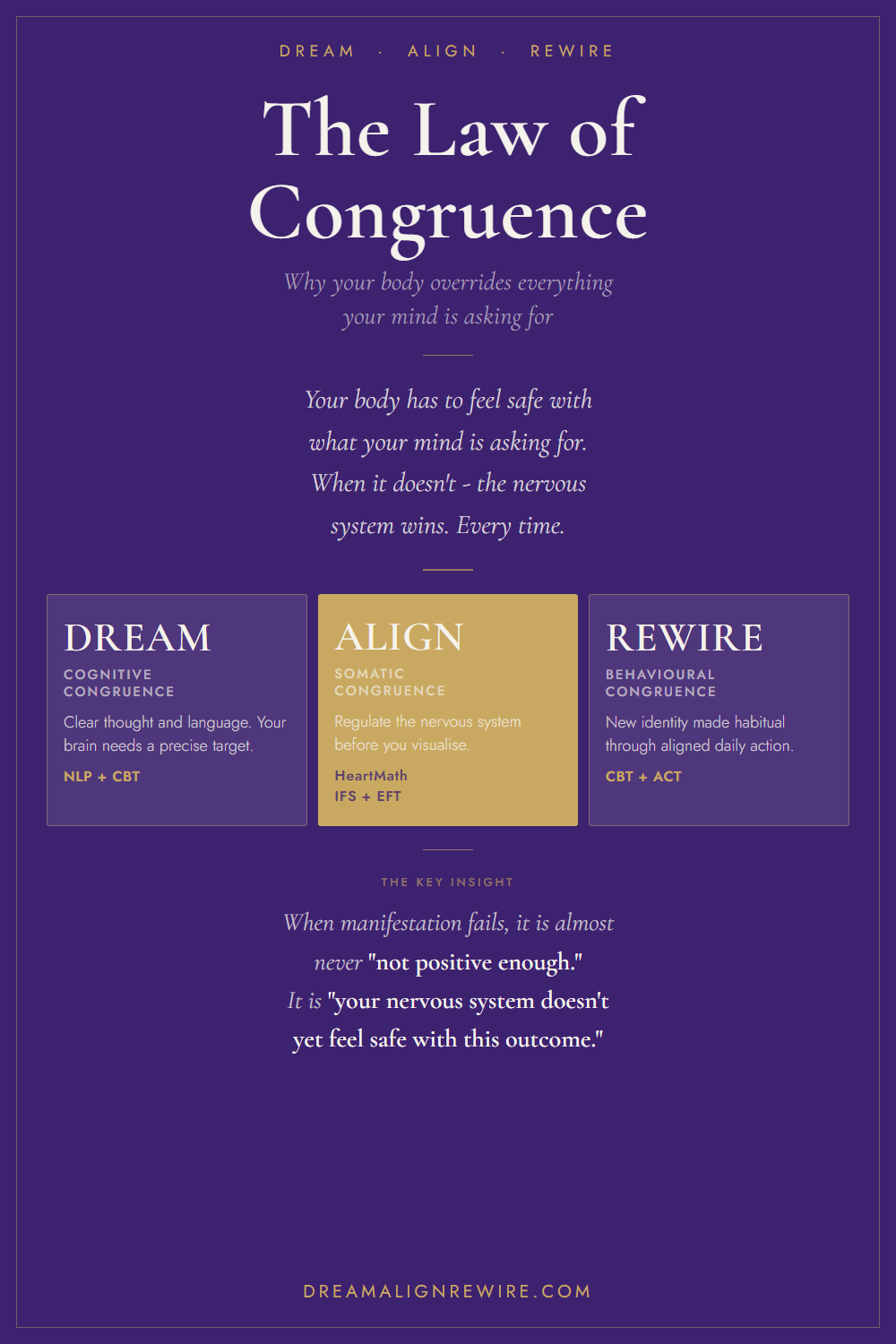
The Law of Congruence states that external transformation is only possible when the physical nervous system is in total agreement with the conscious intention.
In plain language: your body has to feel safe with what your mind is asking for.
When there is conflict between what you want (the Dream) and what your nervous system believes is safe (the felt sense of danger), the nervous system wins. Every time. This is not a character flaw. It is biology. Your body is designed to keep you alive, and to a nervous system shaped by old experiences of scarcity or threat, a big new life can feel exactly as dangerous as a predator.
This is why visualisation sometimes works brilliantly - and sometimes creates a low-grade anxiety you cannot explain. You are asking your body to hold a future it does not yet feel safe in.
The Law of Congruence does not ask you to think harder or believe more. It asks you to do something more fundamental: make it safe for your body to hold the new reality.
Free daily practice guide
The Morning Coherence Practice
A free 5-minute daily practice built on HeartMath and NLP principles. Creates the physiological conditions for the Law of Congruence to work - before you start your day.
Get the free downloadWhy Attraction and Assumption Are Incomplete
Before we go further, it is worth being precise. The Law of Attraction and the Law of Assumption are not wrong. They are pointing at something real. The problem is that they both assume a functioning nervous system - one that is already settled, already resourced, already operating from a baseline of safety.
For many people, that assumption is the gap.
Here is how the three approaches compare:
| Feature | The Law of Attraction | The Law of Assumption | The Law of Congruence |
|---|---|---|---|
| Driver | Emotions and vibration | Imagination and belief | Somatic safety and integration |
| The "How" | Stay positive | Live in the end | Calm the body first |
| Failure Mode | "You weren't positive enough" | "You didn't believe hard enough" | "Your body is trying to protect you" |
| Solution | Visualise more | Imagine more | Align the nervous system first |
Notice the difference in the failure mode column. The first two place the cause of failure inside the person's effort or mindset. The Law of Congruence does not blame. It explains. Your body is not sabotaging you. It is protecting you - using the only tools it has.
Once you understand that, everything changes.
The Anatomy of Incongruence
Incongruence is what it feels like when your mind wants one thing and your body refuses to cooperate.
You might recognise it as the thought spiral that starts just after you have done something brave: the sudden conviction that you are a fraud, that it will fall apart, that you spoke too soon. Or the invisible ceiling on your income that you keep bumping against despite the work and the planning. Or the way you start to feel genuinely unwell when success starts to arrive.
None of that is random. It is your nervous system doing its job.
The psychologist Stephen Porges mapped out how the autonomic nervous system responds to perceived threat through what he called the Polyvagal Theory. When the system detects danger - whether from a predator or from the idea of being seen and judged - it moves from a state of social engagement (calm, connected, creative) into sympathetic activation (fight or flight) or dorsal vagal shutdown (freeze, collapse, disappear).
Most manifestation teaching assumes you are operating from social engagement. But if your nervous system learned early that being visible was dangerous, that money created conflict, or that wanting things led to disappointment - it will respond to your visualisation of abundance the same way it responds to a threat. It will try to keep you safe.
This is what Neville Goddard meant when he talked about states, and what Florence Scovel Shinn was circling around with her concept of divine right action. The body has to be in the right state first. Neither of them had the neuroscience language to say it directly - but the Law of Congruence does.
Take it deeper
The Science of Getting Rich - Annotated Edition
Wallace Wattles' 1910 framework for cognitive congruence - the 'Certain Way' decoded with polyvagal theory and modern neuroscience. The book that most directly anticipated the Law of Congruence.
From £3.99 on Kindle Unlimited
Read the annotated editionThe Three Phases of Congruence
The Law of Congruence works through three phases, in sequence. You need all three. Working on just one is like trying to stand a stool on one leg.
Phase One: The Dream - Nervous System Safety and Vision
Before the vision gets precise, your body has to feel safe enough to want it.
This is why Dream starts with calming the body, not goal-setting. Breathwork, HeartMath, EFT, gentle movement - whatever helps your body feel calm rather than braced. Without this step, even the clearest vision will not land, because a nervous system in threat mode cannot hold a big future. It can only hold survival.
Once the body is calm enough, Dream moves into building the vision itself - specific enough that your brain's attention filter can actually search for it. This filter is the part of your brain that sorts the millions of signals arriving every second down to the handful you consciously notice, based on what you have told it matters. A vague intention gets vague filtering. A precise, emotionally specific vision gives it a target.
NLP does the precision work here: values elicitation, future pacing, getting an inkling of who you need to become. The subconscious mind processes language literally, so "I don't want to be broke" still encodes the word "broke." Precise, positive, present-tense language is not positive thinking for its own sake - it gives your filtering system clean instructions.
Phase Two: The Align - Conscious Mind Congruence
This is the piece most manifestation teaching skips entirely: the beliefs that actively contradict the vision, sitting there unexamined.
Align works at the level of the thinking mind - the part that can question, reason, and choose. This is CBT's territory: catching and challenging the old scripts. "This won't work." "I'm not good enough." "People like me don't have that." These are protection thoughts. They arose for good reasons. But they are not the truth - they are old data, not a current threat assessment.
IFS offers a language for what is happening psychologically. The part of you that keeps you small is not a villain. It is a Protector - a part of your psyche that learned, often very young, that staying small kept you safe. Wealth created conflict. Visibility led to judgment. Wanting things led to disappointment. The Protector is doing exactly what it was designed to do.
The breakthrough in IFS is not fighting the Protector. It is talking to it. Acknowledging its job. Then, as the adult self who actually has agency now, letting it know the threat it is guarding against is old. The mind changes its verdict when it is heard, not when it is overridden.
EFT also does work at this level - tapping on meridian points while naming the fear releases the emotional charge attached to a specific belief or memory, so the belief stops running the show unexamined.
Phase Three: The Rewire - Subconscious Congruence
This is where the new identity stops being something you choose and becomes something you are.
Rewire works below conscious awareness, at the level of patterns installed long before you had words for them. This is NLP's territory: anchoring, submodalities, timeline work, future self embodiment. The goal is repetition until the new response is automatic under pressure - not a performance you have to remember to give.
What you feel in your body matters here too. Rewire is where the new identity gets embodied, not just understood - practising the posture, the pace, the way of moving through a room that belongs to the person you are becoming. Ho'oponopono clears residual old patterns still trying to resurface. Habit stacking - anchoring new behaviours to existing ones - is how the new identity builds momentum without requiring heroic willpower.
You do not need to feel fearless to act from this identity. You need the new response to be automatic enough that it shows up even when the fear is still present.
The Law of Congruence in Practice
Here is what the three phases look like as a daily practice.
The Morning Coherence Session (Dream): Five minutes of heart-focused breathing. Breathe slowly, evenly, as if the breath is moving directly through your heart. Once the body is calm, visualise one specific outcome - precise enough that you could recognise it. Then say a statement that affirms your safety: "It is safe for me to be an adult who has plenty."
The Witness Practice (Align): At some point in the day, spend two minutes with the Protector part of yourself. Acknowledge that it has been working very hard to keep you safe. Then, from the adult perspective - the one who can assess actual risk now - let it know you are taking the lead.
The Certain Action (Rewire): One task that directly connects to the life you are building. When the thought "this won't work" appears, write it down. Then flip it: "That is a protection thought. The truth is, I am creating congruence right now."
The Evening Evidence Log: Three things that went right today. Not grand achievements. Just evidence that you are moving - however slowly - in the direction of what you want. This is not toxic positivity. It is deliberate attention training. Your brain has a negativity bias. The Evidence Log is how you rebalance it.
Free daily practice guide
The Morning Coherence Practice
A free 5-minute daily practice built on HeartMath and NLP principles. Creates the physiological conditions for the Law of Congruence to work - before you start your day.
Get the free downloadWhy This Matters if You Have Tried Everything
If you have been working with the Law of Attraction or the Law of Assumption and something is still not working, the Law of Congruence is probably not telling you that you have failed. It is telling you where to look.
The question is not: did I think positively enough? The question is: does my body feel safe with this?
And if the answer is no - not yet - that is not a judgment. It is information. It is the starting point.
The old masters knew something real. Neville Goddard knew that the felt sense of the wish fulfilled was the key. Wallace Wattles knew that competitive thinking blocked creative thinking. Florence Scovel Shinn knew that there was a higher order operating beneath the surface. But they were working without brain science, without trauma research, without polyvagal theory, without fifty years of somatic therapy.
The Law of Congruence is what you get when you take what they knew and add what we now understand about the body.
It does not ask you to believe harder. It asks you to make it safe to believe at all.
Frequently asked questions
- What is the Law of Congruence?
- The Law of Congruence states that external transformation is only possible when the physical nervous system is in total agreement with the conscious intention. In plain language: your body has to feel safe with what your mind is asking for. When there is conflict between the two, the nervous system wins - not because you are broken, but because your body is designed to keep you safe.
- How is the Law of Congruence different from the Law of Attraction?
- The Law of Attraction focuses on thoughts and emotions as the mechanism for attracting outcomes. The Law of Congruence goes deeper: it explains why the Law of Attraction works when it works (the nervous system is calm and congruent) and why it fails when it fails (the nervous system perceives the desired outcome as a threat). The Law of Congruence does not replace the Law of Attraction - it gives it a physiological foundation.
- What are the three pillars of the Law of Congruence?
- The Dream - settling the nervous system enough to want something honestly, then building a vision precise enough to act on, using body-based calming practices and NLP. The Align - the conscious work. Using CBT to catch and challenge the beliefs that contradict the vision. The Rewire - subconscious work using NLP to make the new identity automatic, so it becomes the first response instead of something you have to choose every time.
- What is the Core 4 daily practice for the Law of Congruence?
- The Core 4 is: the Morning Coherence Session (5 minutes of heart-focused breathing and precise visualisation); the Witness Practice (2 minutes acknowledging and dialoguing with the protective part of yourself); the Certain Action (one task that directly connects to the life you are building); and the Evening Evidence Log (three pieces of evidence that you are moving in the right direction). Together, these address all three pillars daily.
- Why does visualisation sometimes cause anxiety rather than motivation?
- When your nervous system learned early that a big life was dangerous - that visibility led to judgment, that money caused conflict, that wanting things led to disappointment - it will respond to your visualisation of abundance the same way it responds to a threat. The protective response is not a character flaw. It is biology. The Law of Congruence addresses this directly by calming the body before visualisation, rather than trying to override the nervous system with more positive thinking.
About the author
Lesley Christie
Lesley Christie has spent decades reading everything she could find - the modern personal development shelf first, then the New Thought writers it all grew from: James Allen, Neville Goddard, Wallace D. Wattles. She understood the methods. She still couldn't make them work consistently. For years she put it down to mindset. It wasn't. The answer was the nervous system - what Lesley now calls the Body Dreambuster: the part of you that quietly kills the dream before it can take hold, not out of malice, but out of protection. No amount of visualisation, affirmation, or positive thinking overrides a protection programme running below conscious awareness. A Certified Human Design Specialist, Certified Trauma-Informed Somatic Life Coach, and CBT Coach Practitioner, a NLP Master Practitioner, qualified in EFT, Ho'oponopono, meditation, and self-hypnosis, Lesley built Dream.Align.Rewire around the Law of Congruence - the principle that external change is only possible when your internal system feels safe enough to hold it. Not when you believe hard enough.